Odoo Integration Services for CRM, eCommerce, Payments, and Logistics
The most common ERP-eCommerce sync failure isn’t a crash. It’s quieter than that. A delayed inventory update from batch processing, and nobody notices until a customer orders something that’s already out of stock. Most Odoo integration services work the same way: no error message, just a silent gap between two systems that both look perfectly fine on their own.
Four areas account for most of the Odoo integration requests we see. Here’s where each one actually breaks.
CRM Integration
Which system owns the customer record? That’s really the whole question, whether you’re running Odoo alongside a separate CRM or debating consolidating into Odoo’s own. Get the answer wrong and duplicate contacts start piling up, deal stages start conflicting between the two systems, and your sales team quietly stops trusting either one.
What holds up in practice: assign one system as the golden record per entity. Customer data lives in one source, deal stage lives in the other, and the sync respects that boundary instead of letting both sides write to everything. For simpler syncs, middleware like Zapier or Make handles it without custom code. Once custom fields or non-standard pipeline stages enter the picture, though, you’re into proper API-level integration territory, not a drag-and-drop tool.
eCommerce Integration
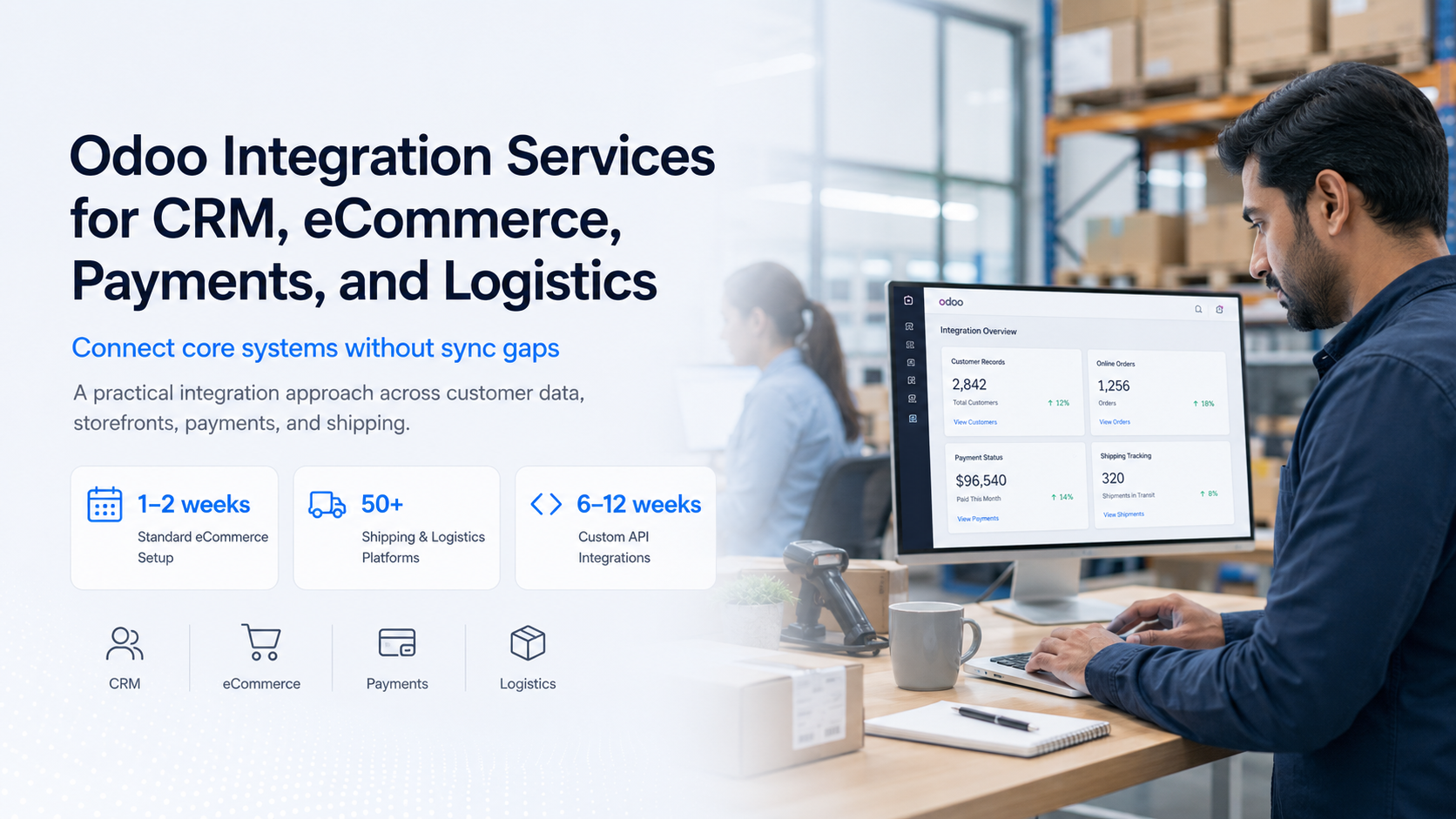
This one’s genuinely fast. Best odoo integration connects to Shopify, WooCommerce, and most other storefronts through native connectors, often live within 1 to 2 weeks for a standard setup. The connection itself was never the hard part.
Sync frequency for inventory is where it gets interesting. Real-time sync stops overselling but adds load, and it can create race conditions when two orders land on the same low-stock item seconds apart. Nightly batch is lighter on infrastructure but leaves a window where your storefront shows stock that’s already gone. Neither option is objectively right. It comes down to how much a stockout costs you versus how much sync infrastructure you actually want to maintain, not which one sounds more modern on a sales call.
Payment Gateway Integration
Least custom work of the four, by a wide margin. Odoo’s native integrations with major processors already cover most standard payment flows, and building custom logic here rarely pays off unless you’ve got an unusual compliance requirement or a regional processor Odoo simply doesn’t support.
Retry handling is the actual failure point, and it’s an ugly one when it happens. A storefront resends a payment confirmation because it never got an acknowledgment. Odoo processes it as a brand new transaction instead of recognizing the retry. Now you’ve got duplicate fulfillment and a finance team spending an afternoon reconciling it. Idempotent handling, where a retried request can never spawn a second transaction, needs to be part of the integration on day one. Not a patch you bolt on after the first duplicate charge lands.
Logistics and Shipping Integration
Odoo talks natively to 50-plus shipping and logistics platforms, covering the major carriers most mid-market businesses actually ship with. Standard carrier setup is one of the faster wins here.
Multi-carrier logistics with rate shopping is where it stops being simple. Same story with a regional carrier that only operates in one country on your shipping map. Both of those push you into custom API work, typically 6 to 12 weeks instead of the 1 to 2 a native connector takes, and it’s worth confirming up front with your Odoo integration partner which category your actual carrier mix falls into. Before you commit to a timeline, not after.
The Question Behind All Four
One decision repeats across all four of these: native connector where it exists and covers your case, custom API work where it doesn’t, and a real answer for what happens when a sync fails partway through. Skip that last piece and you’ll be debugging a mismatch three weeks from now with no log telling you which system was actually right.
Firms like BiztechCS, integrating Odoo across CRM, eCommerce, payments, and logistics for growing businesses, tend to spend the first conversation on failure handling before the connector even comes up, because that’s the part clients almost never think to ask about until it’s already gone wrong once.
So if you’re scoping Odoo integration work: figure out which of these four areas has the least tolerance for a delayed or duplicated record, and let that drive your sync strategy. At BiztechCS, that’s the question that shapes the rest of the plan.