Competitor Intelligence in ASO: Using Daily Rank Trackers to Spot Market Shifts
It is difficult to stand out among other mobile applications. Data analysis and constant market monitoring are needed for success. Keywords are responsible for driving 65% to 70% of all downloads of mobile apps. The total amount of global spending on in-app purchases has exceeded $167 billion. It is necessary to increase the organic reach of your app to generate additional revenue.
However, it should be noted that the regulations in the app store can be constantly changing depending on the actions of users, the speed of downloading, the number of downloads, and user feedback. Checking the performance of your app only occasionally or even once in a couple of months, you will miss some essential details regarding its performance.
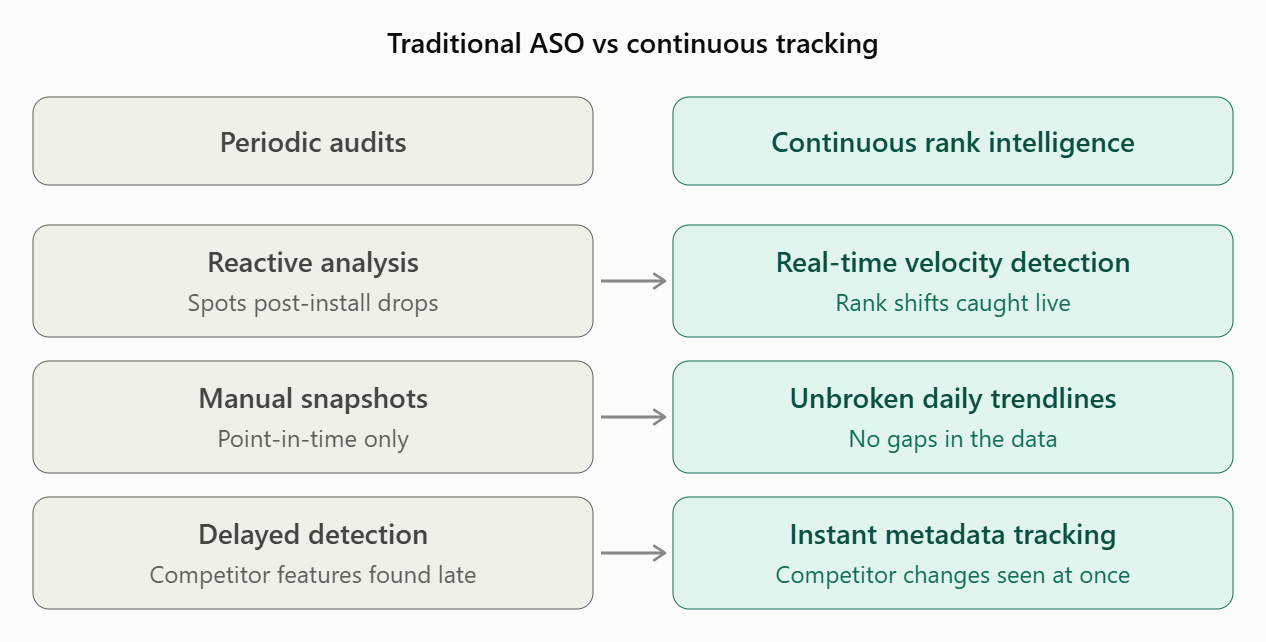
To be a leader in the market, you have to watch data all the time. You should look at your rank changes, see how keywords move, keep up with data from other apps, and see changes in the group or category. A special app rank tracker will help you see these changes early. It lets you catch small changes in the market before they turn into big problems.
The Strategic Shift: Tactical Intelligence Over Reaction
The ASO teams in the past used to have a backward-looking approach. It involved tracking organic install drops several weeks after the algorithm update or emergence of tough competition. In today’s world, however, most growth teams prefer acting quickly. They are aware of the fact that store visibility may drop anytime.
As other organizations create paid advertisements and experiment with new approaches in terms of local ideas and keywords, the ranking positions may be changed quickly. The real-time analysis of the rankings allows the teams to receive signals in a timely manner. It enables them to understand what is happening there and maintain their positions.
Core Metrics: Beyond Category Charts
You need to look at many store signals when you check how you compare to others. All these signals connect with each other, so you have to keep an eye on them.
| Metric Category | Tracking Indicator | Diagnostic Value | Strategic Action |
| Rank Velocity | Daily top-chart movement delta (7d / 30d) | Identifies aggressive paid acquisition (UA) bursts or viral organic loops. | Adjust Apple Search Ads (ASA) bids to protect high-intent keywords. |
| Review Velocity | Spikes in daily review submissions | Indicates feature updates, technical bugs, or reputation purges. | Audit recent release notes and customer support friction points. |
| Keyword Mobility | Position shifts across primary search queries | Signals competitor metadata updates or algorithmic relevancy recalculations. | Update subtitle, title, and hidden keyword fields with high-performing terms. |
| Category Penetration | Sub-category rank relative to global top-free | Benchmarks overall category share against direct market peers. | Reallocate localization budget toward high-converting international regions. |
Detecting Competitor Pivots in Real Time
- Identifying Paid Acquisition Bursts
When another app moves up over 30 spots in a top sub-category in only two days, there is usually some help behind it. Growth teams look at how fast the rank goes up and look at the keyword positions. This lets them know if a paid user action is helping, not just people finding the app on their own. If there is a big change in some places only, it means the move is for new markets in those areas.
2. Spotting Keyword Indexing Opportunities
Search engines in the App Store change their keyword strategy, and it depends on user feedback. It is possible to notice a situation when the top app falls for crucial but non-branded keywords. The moment you identify such a situation, you have a small period to boost your bid for ads. Besides, you need to improve your text in order to attract more users to download your app.
3. Monitoring Creative and Metadata Updates
In most cases, there is a sudden spike in conversions when you perform A/B tests on product images and screenshots. You should consider your position on the graph whenever you update your product page. This would help you understand what kind of changes and features influence buying decisions of other brands independently.
Algorithmic Shifts, Ratings, and Reputation Signals
Ranking algorithms like the apps that many people sign up for or download. The apps need to work well and keep people interested. Real-time analytics help teams see if a drop in ranking is from something that affects everyone in the market or just their own product.
- Algorithms Update: When there is an algorithmic change for a large number of applications within one category, and they happen at the same time, this means that the store itself has changed something related to algorithms. It might be related to the way keyword weights are calculated or even the way the store interprets app retention.
- Individual Application Performance Change: There may be times when only one application is down in its ranking, but other applications are staying the same, which means that something went wrong individually for this app. It may include crashes, poor ratings, or even negative reviews.
Conclusion
In order to succeed in the mobile app industry, you need to observe the market daily. It is important to monitor everything that is happening and how your application is being discovered through the search process. Moreover, you need to monitor your app’s ranking every day. Monitor the activities of others as well. Include an app rank tracker in your growth strategy. It will allow teams to stay in the market, attract more searches for their applications, and maintain leadership in their category.