Concrete Floors Fail From Below
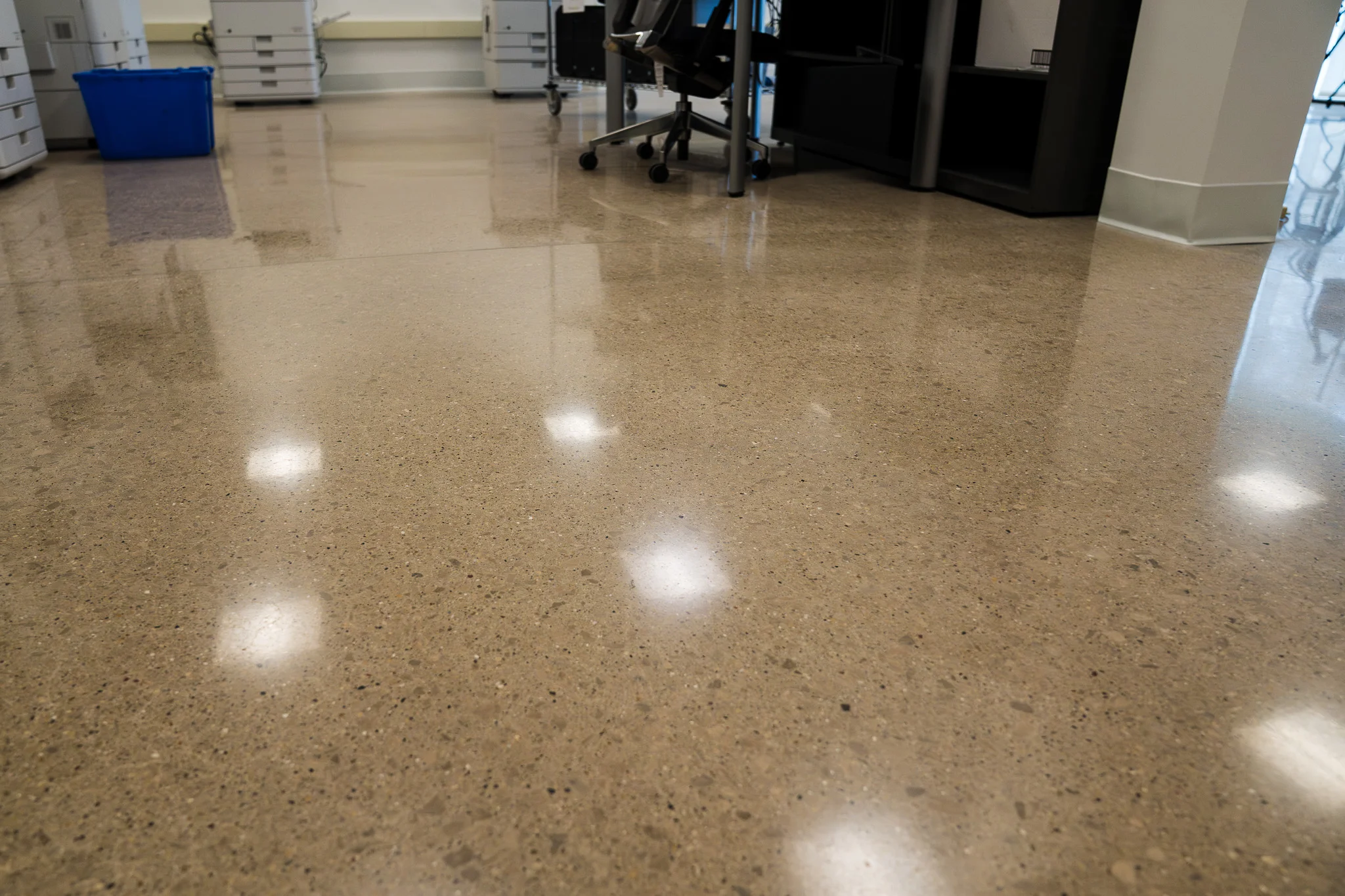
A warehouse resurfaces its floor. Six months later the new coating is lifting in sheets near the loading dock, and the assumption in the room is that somebody bought a cheap product.
Usually that is not what happened. The coating failed because of what was underneath it, and the failure was determined before the first bucket was opened.
Adhesion Is Mechanical, Not Chemical
The intuition most people carry is that a coating sticks because it is sticky. That is roughly true for tape and roughly wrong for concrete coatings.
Epoxy bonds to concrete primarily by penetrating the surface and locking into its texture. That requires an open, porous profile with the top layer of laitance, the weak dusty film left behind by finishing, removed entirely. A troweled floor that looks smooth and clean is frequently the worst possible substrate, because that polish is exactly the layer a coating cannot grip.
Surface preparation is therefore not cleaning. Diamond grinding or shot blasting cuts into the concrete to create a measurable profile, and industry standards describe those profiles on a numbered scale so a specification can name one rather than describing it in adjectives. Different coating thicknesses require different profiles. A thin-film system needs less aggression than a heavy-build one, and matching them incorrectly produces failure at either end: too smooth and the coating peels, too rough and it fails to fully wet out, leaving voids.
This is also where cost gets cut, because preparation is labor-intensive and invisible in the finished result. A quote that is substantially cheaper than its competitors is almost always cheaper here.
Water Moves Through Concrete Constantly
The second failure mode is moisture vapor transmission, and it is the one that defeats otherwise competent installations.
Concrete is permeable. Water vapor moves upward through a slab continuously, driven by ground moisture below. In an uncoated floor this is invisible. Seal the surface and the vapor has nowhere to go, so pressure builds at the interface between coating and concrete until the bond releases.
The result is blistering, or large sheets delaminating with clean concrete visible beneath. The coating was not defective. It was applied over a slab pushing more moisture than the system could tolerate.
Testing for this before installation is standard practice and routinely skipped on fast-turnaround jobs. Relative humidity probes placed in the slab give the most reliable reading, and where the result exceeds the coating’s tolerance, a moisture-mitigating primer handles it. That primer adds cost and a day to the schedule, which is why it gets value-engineered out and why the failure recurs so predictably.
Slabs without a vapor barrier beneath them, common in older buildings, are the highest risk. So is any slab poured recently, since fresh concrete releases moisture for weeks.
Thin, Thick, And What They Are Actually For
Specifying epoxy floor protection by thickness rather than by use case is a reliable way to buy the wrong system.
Thin-film systems, measured in a few mils, are essentially sealers. They resist dust, make cleaning easier, and improve appearance. They do not resist impact and they wear through under wheeled traffic.
Self-leveling systems at a quarter inch or more provide genuine impact resistance and can correct minor surface irregularities. This is the range most industrial and commercial installations need.
Mortar systems, thicker still and loaded with aggregate, handle heavy impact, steel-wheeled traffic, and thermal shock. They are specified where forklifts run constantly or where hot liquids hit the floor.
Chemistry matters as much as thickness. Standard epoxy resists many chemicals well but yellows under UV exposure and softens at elevated temperatures. Novolac formulations handle aggressive acids that would destroy standard epoxy. Urethane topcoats add UV stability and abrasion resistance. Polyaspartic systems cure fast enough to return a space to service in a day, which is often worth more than the material premium.
A specification naming only a thickness and a color has left every decision that matters unmade.
Where Coatings Actually Break
Failures cluster in predictable locations.
Transitions and terminations fail first. Doorways, drains, expansion joints, and the edges where coating meets an uncoated surface all concentrate stress. Detailing at these points separates installations that last from ones that look identical on day one and diverge within a year.
Coving at wall junctions is the difference between a floor that can be washed down and one where water gets behind the coating at the perimeter. Any facility with sanitation requirements needs this, and it is frequently omitted to save money.
Cracks that were patched with filler rather than properly routed and structurally repaired will reappear through the coating. The coating is not a structural element and cannot bridge movement.
Conditions During Install Are Part Of The Spec
Epoxy cures through a chemical reaction sensitive to temperature and humidity.
Below roughly 50 degrees Fahrenheit, cure slows dramatically and may never complete, leaving a soft floor that never reaches design hardness. High humidity during cure can produce amine blush, a hazy surface film that prevents adhesion of subsequent coats.
Slab temperature matters more than air temperature, and the two diverge significantly. A concrete floor in an unheated building tracks the ground beneath it, not the space heater someone brought in that morning.
Facilities scheduling work in cold months need to account for this in the plan rather than discovering it during installation.
Three Questions Before Signing
Ask what surface profile the specification calls for and how it will be achieved. A contractor who cannot name a standard profile number has not specified preparation.
Ask whether moisture testing will be performed and what the contingency is if the slab exceeds tolerance. The answer determines whether a mitigation primer is priced into the quote or becomes a change order mid-job.
Ask how transitions, drains, and joints will be detailed. Those are where the floor will fail, and the answer reveals how carefully the rest was considered.
A floor coating is a system rather than a product. The part that determines its lifespan is finished before anything visible gets applied.