Building HIPAA- and FERPA-Safe Platforms for Medical Education: Lessons from a Real Project
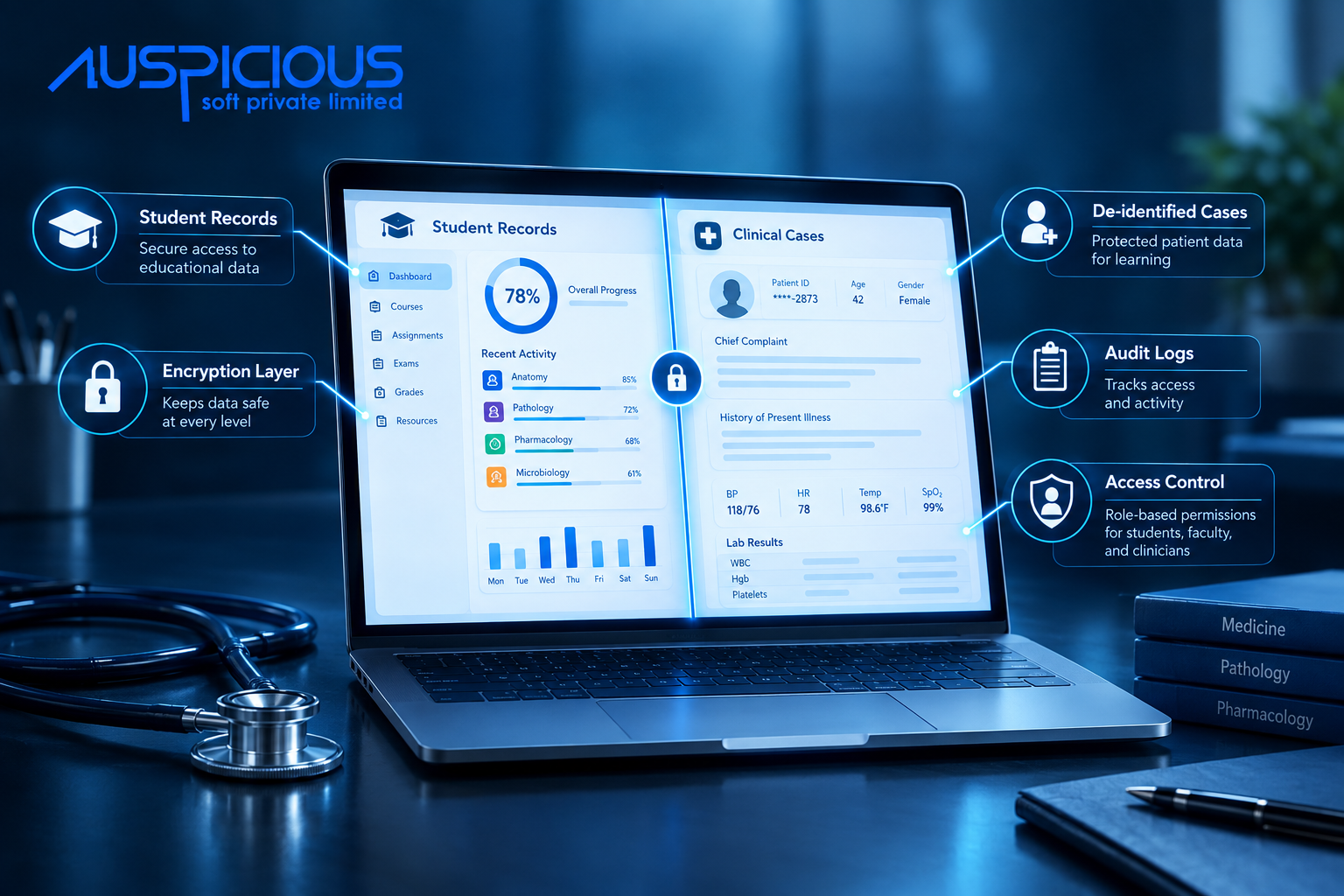
Most education platforms answer to one privacy law. Most healthcare platforms answer to another. Medical education sits right between them, and that’s where many projects run into trouble.
Think about a medical student’s typical day. In the morning, they take a practice exam and review feedback from a tutor. In the afternoon, they log a patient encounter from their clinical rotation. The first activity creates education data, usually protected by FERPA. The second can involve patient data protected by HIPAA. Same student, same app, two very different sets of rules.
That’s why education software development for healthcare learners needs more care than building a standard LMS or tutoring app. Compliance isn’t one checkbox at the end. It’s a chain of decisions that starts before the first screen is designed.
At Auspicious Soft, we worked through these decisions while building a full-stack platform for MedSchoolCoach, a US company that supports aspiring doctors from pre-med to residency through tutoring, exam prep, and admissions advising, and that also partners with universities and medical schools. Below, we share what we learned, what we’d repeat, and what we’d tell any founder or program director planning something similar.
HIPAA vs. FERPA: The Short Version
FERPA (the Family Educational Rights and Privacy Act) protects student education records. It applies to schools that receive funding from the US Department of Education. Vendors usually come under it through contracts with those schools.
HIPAA (the Health Insurance Portability and Accountability Act) protects identifiable health information, known as PHI. It applies to healthcare providers, health plans, and clearinghouses, plus the vendors who handle PHI for them, called business associates. Those vendors must sign a Business Associate Agreement (BAA).
The detail that surprises most people is that records covered by FERPA are excluded from HIPAA’s definition of PHI. The Departments of Education and Health and Human Services explain this in their joint guidance on FERPA and HIPAA.
So a medical student’s vaccination record kept by their university is usually an education record, not PHI. But patient details that the same student enters into a case log may still be PHI, because that information belongs to the hospital’s patient, not the school’s student.
That’s why the useful question isn’t “Are we HIPAA compliant?” It’s this: which law applies to each piece of data, and who holds it?
Start With a Data Map, Not a Feature List
Before we designed anything, we listed every type of data the platform would touch. No other step shaped the architecture as much.
For most medical education platforms, the categories look like this:
- Profile data: names, emails, school, graduation year.
- Performance data: practice scores, question-bank history, progress analytics.
- Advising and tutoring records: session notes, personal statements, recorded sessions.
- Institutional data: rosters and outcomes shared by partner schools.
- Clinical learning content: cases, patient scenarios, and teaching images.
For each category, we documented which law could apply, who owns the data, where it lives, who can access it, and how long it’s kept.
A private coaching or test-prep company usually isn’t covered by FERPA on its own. That changes when a university shares student records with it. The company then works under the school’s FERPA obligations, typically through the “school official” exception, and can use that data only for the purpose the school approved. For businesses that serve both individual students and institutions, the same person’s data may follow different rules depending on how they signed up.
State laws matter too. Washington’s My Health My Data Act, for example, regulates consumer health data held by companies that HIPAA doesn’t cover. A good data map flags state requirements alongside federal ones.
8 Lessons From the Build
1. Treat each institution as its own trust boundary
When schools buy access for their students, the data comes with conditions. FERPA generally prohibits sharing it further, and the school must remain in “direct control” of how it’s used.
So we separated each institution’s data so one school’s admin could never see another school’s students. We limited institutional reports to what each school is entitled to. And we made sure contracts covered purpose, retention, and deletion on request.
This also made sales easier. University IT and procurement teams ask about data separation early, and a clear answer shortens security reviews.
2. Keep real patient data out of learning content
Clinical cases are the core of medical education, and they’re also where PHI slips in most easily. A teaching image with a name in the corner, or a case with an admission date and a rare diagnosis from a small town, can identify a real person.
Our rule was that learning content is de-identified or synthetic by default. HHS describes two approaches in its de-identification guidance. The Safe Harbor method removes 18 specific identifiers. The Expert Determination method has a qualified expert confirm that the risk of re-identification is very small. For most teaching content, Safe Harbor plus a human review before publishing works well.
It also helps to strip image metadata on upload and scan files for obvious identifiers before anything goes live.
3. Build roles around real people
Students, tutors, advisors, institutional admins, content creators, and support staff all need different access. We built role-based permissions around least privilege. A tutor sees only their own students’ progress. Support staff can reset a password without opening advising notes.
Every access to sensitive records goes into an audit log that the people being tracked can’t edit. Audit logs feel like overhead until a school asks, “Who viewed this student’s file last semester?” Then they’re the only thing that matters.
4. Encrypt everything, including what people forget
Encryption in transit and at rest is expected today. What teams often miss is key management: who can access encryption keys, how often they’re rotated, and whether backups and logs get the same protection as the live database.
We used HIPAA-eligible cloud services under the provider’s BAA and gave backups, file storage, and logs the same care as production data. Unprotected backups and misconfigured storage cause a surprising share of real breaches.
5. Treat every third-party tool as a compliance decision
Your own code may be solid, but other tools see your data too: the video service for tutoring sessions, the email service for score reports, the analytics script on the dashboard, the support chat widget.
Any vendor that might touch PHI must sign a BAA. Any vendor handling institutional student data needs contract terms that match FERPA’s limits. HHS has also issued guidance on online tracking technologies. A federal court narrowed part of it in 2024, but the safest approach is still to keep marketing pixels off logged-in pages.
We kept a living vendor list showing what data each tool touches and which agreement covers it, and we reviewed it every time a new integration was added.
6. Put guardrails on AI features
AI study plans, adaptive question banks, essay feedback, and tutoring assistants can genuinely help medical students. They also create new ways for sensitive data to leave your system.
Our guardrails:
- Never send identifiable student or patient data to an AI model without a proper agreement and zero-retention settings where available.
- Ground AI answers in vetted content using retrieval-augmented generation (RAG), so the model isn’t improvising medical facts.
- Keep a human involved in anything that affects grades, applications, or advising outcomes.
7. Write the breach plan before launch
Under the HIPAA Breach Notification Rule, affected individuals must be told without unreasonable delay and within 60 days of discovery. Larger breaches must also be reported to HHS and sometimes the media. Institutional contracts often require even faster notice.
We wrote the incident response plan alongside the architecture. It covered who gets alerted, how systems are isolated, who contacts partner schools, and how evidence is preserved. A plan written calmly before launch works far better than one written in a crisis.
8. Make compliance a habit, not a launch task
HIPAA’s Security Rule expects ongoing risk analysis, not a one-time audit, and HHS proposed stricter Security Rule updates in early 2025, so it’s worth checking where they stand. FERPA obligations also shift as contracts and features change. We made access reviews, dependency updates, and security testing part of regular maintenance.
How Compliance Affects Your Budget and Timeline
Building privacy in from day one adds some effort up front. Adding it later costs far more. We’ve seen teams spend months untangling shared databases, replacing vendors that refuse to sign a BAA, and rebuilding permission systems that were never designed for institutional customers.
In a well-planned project, compliance work shows up in four places. Discovery includes data mapping and legal review. Architecture covers data separation, encryption, and audit logging. Vendor selection narrows because fewer tools qualify, and compliant plans often cost more. And testing expands to include access-control and security checks, not just features.
How to Choose the Right Development Partner
Before you hire a software development company for a medical education product, ask:
- Have you built platforms that handle both student records and health-related data? Can you walk me through one?
- How do you decide whether data falls under FERPA, HIPAA, both, or neither?
- Which cloud and third-party services will you use, and which will sign a BAA?
- How will you separate data between institutional customers?
- What do your audit logs record, and who can change them?
- How do you de-identify clinical learning content?
- What happens in the first 24 hours after a security incident?
A strong partner answers plainly and talks openly about trade-offs. Be cautious with anyone who just says “we’re fully compliant.”
Ready to Build a Compliant Medical Education Platform?
The biggest lesson from our work is simple: decide where every piece of data belongs before deciding what the product looks like. Architecture, vendors, and AI features all get easier once that map exists.
If you’re planning an LMS, exam-prep app, or learning platform for healthcare students, our education software development team can help you get the foundation right from day one. As a software development company that has delivered 200+ projects for startups and institutions across the USA, we know where compliance projects go wrong and how to avoid it.
Frequently Asked Questions
1. What does an education software development company actually do?
An education software development company designs and builds digital learning products such as learning management systems, exam-prep apps, tutoring platforms, and student portals. For medical education, the work also includes handling privacy requirements under FERPA and, in some cases, HIPAA.
2. Does HIPAA apply to medical education platforms?
It depends on the data. Student education records generally fall under FERPA. HIPAA applies when the platform handles identifiable patient information, such as clinical encounter logs or content drawn from a hospital’s patient records. In those cases, a BAA is usually required.
3. Does FERPA apply to private edtech and test-prep companies?
Usually not directly, since FERPA applies to schools that receive federal education funding. But when a school shares student records with a vendor, the vendor must follow FERPA’s limits on use and sharing, typically through a contract under the school official exception.
4. Do FERPA rights apply to medical students?
Yes. Once a student turns 18 or enters a college or university, FERPA rights transfer from parents to the student. Medical schools and their vendors deal directly with students on access and consent.
5. Is there an official HIPAA or FERPA certification for software?
No. Neither HHS nor the Department of Education certifies software. Compliance depends on how a platform is built, configured, contracted, and run. Independent audits such as SOC 2 or HITRUST can help show buyers that security practices are sound.
6. Can students log patient encounters on an education platform?
Yes, if it’s done carefully. The safest approach is to collect only de-identified details, such as age range, diagnosis category, and procedure type, with no names, dates, or record numbers. If identifiable data is truly needed, the platform will likely need a BAA and full HIPAA safeguards.
7. Are AWS, Azure, and Google Cloud HIPAA compliant?
All three offer HIPAA-eligible services and will sign a BAA. But hosting on them doesn’t make an application compliant on its own. The development team still has to configure access controls, encryption, and logging correctly.
8. Can an offshore software development company build HIPAA-compliant software?
Yes. HIPAA doesn’t prohibit offshore development. What matters is how access to real data is controlled. Experienced teams build and test with synthetic or de-identified data, limit production access to a few people, and cover everything with BAAs and clear contracts. Some institutional or government contracts add their own location rules, so check yours.
9. How much does education software development cost for a compliant platform?
Cost depends on scope. As a rough guide, a focused MVP such as an exam-prep app or tutoring portal may start around $30,000 to $60,000. A multi-institution platform with video, analytics, and AI features can run well into six figures. Compliance adds effort to discovery, architecture, and testing, so a scoped estimate based on your features is the most reliable number.
10. How long does it take to build a medical education platform?
Simpler apps often take two to three months. Platforms with integrations, institutional dashboards, and compliance requirements usually take four to six months or longer. Clear data mapping at the start is the best way to keep timelines on track.
11. What features do medical education platforms need most?
Common essentials include question banks with performance analytics, tutoring and advising schedules, secure video sessions, progress dashboards, institutional reporting, and content management for cases and lessons. AI study plans and adaptive practice are quickly becoming expected.
12. Can we use AI tools like ChatGPT with student or patient data?
Only with proper safeguards. Use enterprise or API plans with the right agreements, turn off data retention where possible, avoid sending identifiable information unless it’s contractually covered, and ground answers in vetted content.
13. What happens if a platform violates HIPAA or FERPA?
HIPAA violations can bring civil penalties, corrective action plans, and required breach notices. FERPA is enforced against schools, which risk losing federal funding, so schools pass that pressure to vendors through strict contracts. For most vendors, the fastest cost is lost institutional business and trust.
14. How do I choose the right software development company for an edtech project?
Look for proven work in education and healthcare, clear answers on data handling and vendor agreements, transparent pricing, and a team that asks about your data before your features. Case studies with real results are the best proof.