Managed SD-WAN: Navigating the Future of Enterprise Networking
Key Takeaways
- Managed SD-WAN adoption is rapidly increasing, driven by higher performance and robust security features.
- Emerging technologies such as 5G and AI are influencing the direction and capabilities of SD-WAN deployments.
- Addressing security vulnerabilities and consolidating vendors are essential to streamlined, secure operations.
Table of Contents
- Rising Adoption of Managed SD-WAN
- Integration with Emerging Technologies
- Addressing Security Challenges
- Vendor Consolidation and Hybrid Operations
- Future Prospects and Market Growth
Enterprises are experiencing a critical transformation in how they connect people, data, and applications across vast, distributed environments. The rapid digitization of business processes means that traditional networks can no longer keep up with demands for flexibility, security, and reliability. This shift has led organizations to embrace SD-WAN solutions that can be managed end-to-end by trusted service providers. As bandwidth requirements soar and remote work continues to redefine the enterprise perimeter, businesses require networks that are agile, simple to operate, and secure from evolving cyber threats.
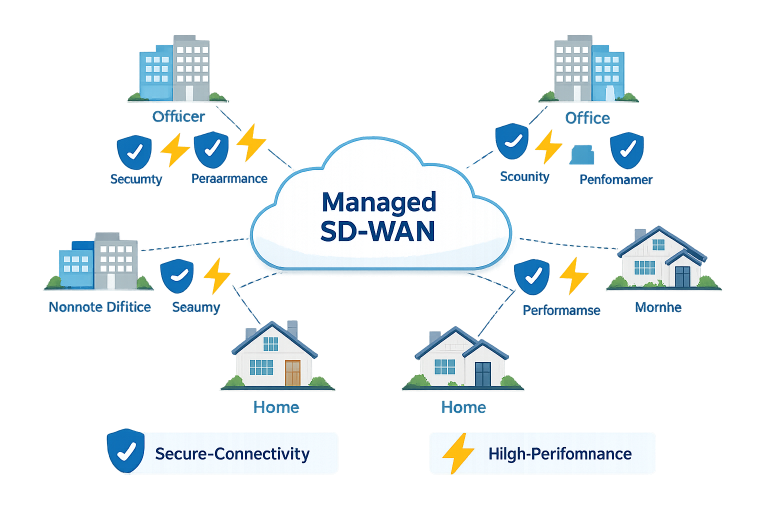
SD-WAN is no longer just about cost savings or simplified branch networking. Managed SD-WAN brings advanced capabilities that address application performance, zero-trust security, and cloud integration, challenging enterprises to rethink their network strategy. It offers deep visibility, centralized control, and automated operations via cloud-based orchestrators, empowering IT teams to focus on business innovation rather than complex network maintenance.
Rising Adoption of Managed SD-WAN
Organizations around the world are making the shift to managed SD-WAN to achieve faster, more reliable connectivity while offloading the complexity of network management. Industry research indicates a significant uptick in adoption rates; a recent Enterprise Management Associates survey revealed that managed SD-WAN uptake grew from 62% of enterprises in 2020 to over 66% in 2023. This momentum reflects a larger trend: businesses are focusing on agility, business continuity, and the need to support distributed workforces without sacrificing control or performance.
Managed SD-WAN services deliver more than just the hardware or software. By leveraging managed offerings, businesses gain access to a suite of lifecycle services, from design and deployment to monitoring and troubleshooting, ensuring optimal performance of mission-critical workloads. The ability to prioritize application traffic, enforce consistent security policies, and adapt network configurations on the fly makes managed SD-WAN an attractive choice for forward-thinking IT leaders.
Integration with Emerging Technologies
Technological innovation is reshaping the capabilities and reach of managed SD-WAN. One of the most transformative developments is the introduction of 5G networks, which deliver higher throughputs, lower latency, and new paradigms such as network slicing. Network slicing allows telecom providers to dedicate portions of their infrastructure to specific applications or users, optimizing service delivery for multiple scenarios. Industries such as public safety, retail, and healthcare are already experimenting with single-slice 5G deployments for essential functions. The next evolution will involve multi-slice environments, tailored for everything from secure telemedicine streams to robust remote monitoring in manufacturing.
Achieving this level of application-specific networking hinges on collaboration between technologies such as the UE Route Selection Policy (URSP), which guides data flow on mobile devices, and SD-WAN’s flexible traffic-mapping at enterprise scale. This hybrid approach empowers organizations to maintain performance and security across complex, mobile, and highly distributed environments. Enterprises are advised to start evaluating their readiness for these integrations today and to build a roadmap for AI-driven, cloud-first, and multi-slice SD-WAN networks that will define connectivity tomorrow. For further reading, visit TechCrunch’s article on Juniper Networks’ acquisition of AI SD-WAN startup 128 Technology.
Addressing Security Challenges
Security is one of the most urgent concerns in managed SD-WAN deployments. Recent headlines have underscored the severity of vulnerabilities, such as the widely cited CVE-2026-20127 in Cisco Catalyst SD-WAN Controllers. This critical flaw, with the highest possible CVSS score, has exposed countless organizations to the risk of unauthorized network control by sophisticated attackers. High-profile advisories, including responses from the U.S. Cybersecurity and Infrastructure Security Agency (CISA), have urged companies to patch urgently, monitor for unusual device activity, and segment management interfaces from the public internet.
To shore up defenses, experts recommend conducting regular security audits of SD-WAN solutions and responding promptly to published vulnerabilities. Protecting management workflows, strictly limiting access, deploying up-to-date patches, and segmenting administrative traffic can make a significant difference. Enterprises must monitor network logs for suspicious connections, isolate compromised systems, and educate IT teams on zero-trust best practices. For a wider perspective on cybersecurity in network infrastructure, see CSO Online’s article on SD-WAN and network security.
Vendor Consolidation and Hybrid Operations
Many enterprises deploy SD-WAN using products from multiple vendors, but industry research shows that this approach is increasingly unsustainable. Around 43% of surveyed organizations manage SD-WAN through two or more vendors, increasing the risk of operational complexity, inconsistent security, and elevated support costs. Vendor consolidation promises to streamline network management, reducing skill set gaps across disparate platforms and providing a unified framework for visibility, enforcement, and incident response.
At the same time, organizations are discovering the value of hybrid operations, which blend the control of co-managed SD-WAN with the efficiency of fully managed services. This hybrid structure enables businesses to retain visibility and oversight of mission-critical infrastructure, while offloading monitoring, updates, and troubleshooting to specialized providers. This balanced approach positions organizations to maximize agility as technologies, business models, and security requirements evolve.
Future Prospects and Market Growth
The global managed SD-WAN market is poised for massive expansion, driven by demand from industries such as manufacturing, healthcare, financial services, and retail. According to Research and Markets, the sector is expected to grow at a compound annual growth rate (CAGR) of 31.60% from 2025 through 2034. This projected growth is being catalyzed by the shift to cloud-based services, the proliferation of remote and hybrid work models, and the rise of security-enhanced network automation. With 5G and AI reshaping what is possible at the edge and in the cloud, SD-WAN is set to become a pillar of digital transformation for organizations of all sizes.
In summary, managed SD-WAN is establishing itself as a foundational component of modern enterprise networking strategies. By staying alert to current trends, proactively addressing security issues, and leveraging the latest technologies, businesses are well-positioned to seize opportunities ahead and ensure their networks are secure, resilient, and future-proof.