Price Action vs Indicator-Based Trading
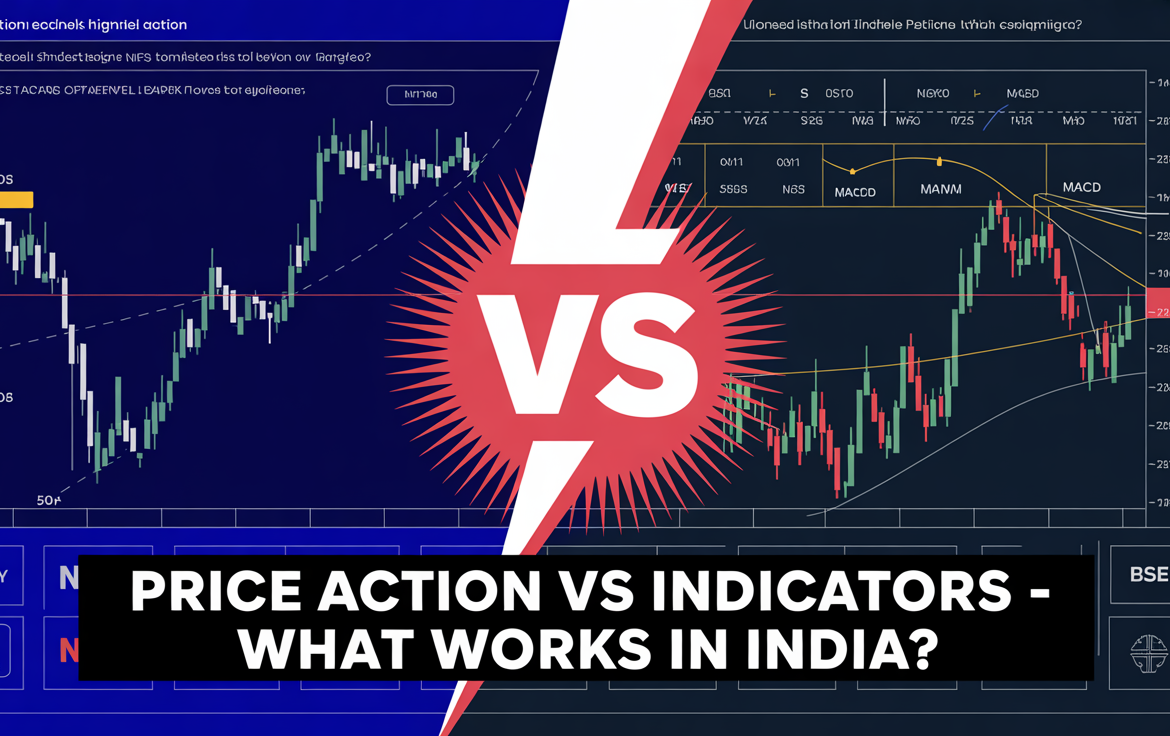
Different methods are used by the traders to analyse the financial markets and identify potential trading opportunities. Price action trading and indicator-based trading are two of the most common methods which traders use. Both methods help traders to understand market behaviour and make better trading decisions, but they rely on different techniques and tools.
While indicator-based trading makes use of technical indicators derived from mathematical computations, price action trading concentrates on analysing the raw movement of price on a chart. Every strategy has benefits and drawbacks, and traders frequently select the one that best fits their trading style and background.
What is Price Action Trading?
Price action trading is a method of analysing the market by observing price movements directly on the chart. In this type of trading, traders study the behaviour of prices to understand market sentiment and identify trading opportunities.
In this type of trading, traders use the following tools for market analysis:
- Candlestick patterns
- Support and resistance levels
- Trend lines
- Chart patterns
- Market structure
A trader might, for instance, watch how the price responds close to a support level or spot a reversal pattern like an engulfing candle or pin bar. Traders can use these signals to identify possible entry and exit points.
What is Indicator-Based Trading?
Indicator-based trading involves using technical indicators to analyse price movements and generate trading signals. These indicators are created using mathematical formulas that process historical price or volume data. Moving averages, Relative Strength Index (RSI), MACD, Stochastic Oscillator, Bollinger Bands, etc., are some of the most common indicators which traders use.
These indicators help traders interpret market trends, momentum, and volatility. For instance, moving averages are usually used to identify trend direction, while indicators like RSI help detect overbought and oversold conditions. Traders who want to improve their market understanding should learn technical analysis.
Key Differences Between Price Action and Indicator-Based Trading
Although both approaches aim to analyse the market, they differ in several important ways.
-
Source of Analysis
In price action trading, traders analyse the market using raw price data from charts. They study how prices behave around important levels to make trading decisions.
In indicator-based trading, traders rely on indicators that are derived from price data using mathematical formulas.
-
Trading Signals
Candlestick patterns, support and resistance zones, and chart structures are used by price action traders to create signals.
Moving average crossovers and momentum indicator levels are examples of indicator signals that are used by indicator-based traders.
-
Ease of reading
Price action traders usually maintain clean and simple charts with minimal indicators.
Use of multiple indicators on same chart can create confusion and makes it look very complex.
-
Learning Time
Price action trading requires more time and experience to understand different aspects of patterns.
Indicator-based trading is considered easier for beginners because indicators provide clearer rules and signals.
-
Speed
Price action is considered faster as traders interpret the market directly from price movements.
Indicators rely on calculations and historical data, due to which indicator-based trading may result in slower signals.
Summary
Traders who are at the beginning stage of trading need to understand the difference between price action trading and indicator-based trading, through which they choose their path. Price action focuses on interpreting raw price movements, while indicator-based trading uses technical indicators to generate signals. You can learn price action trading or indicator trading on Upsurge.club.