SaaS Gross Margin Compression: Why 80% Software Margins Are Disappearing
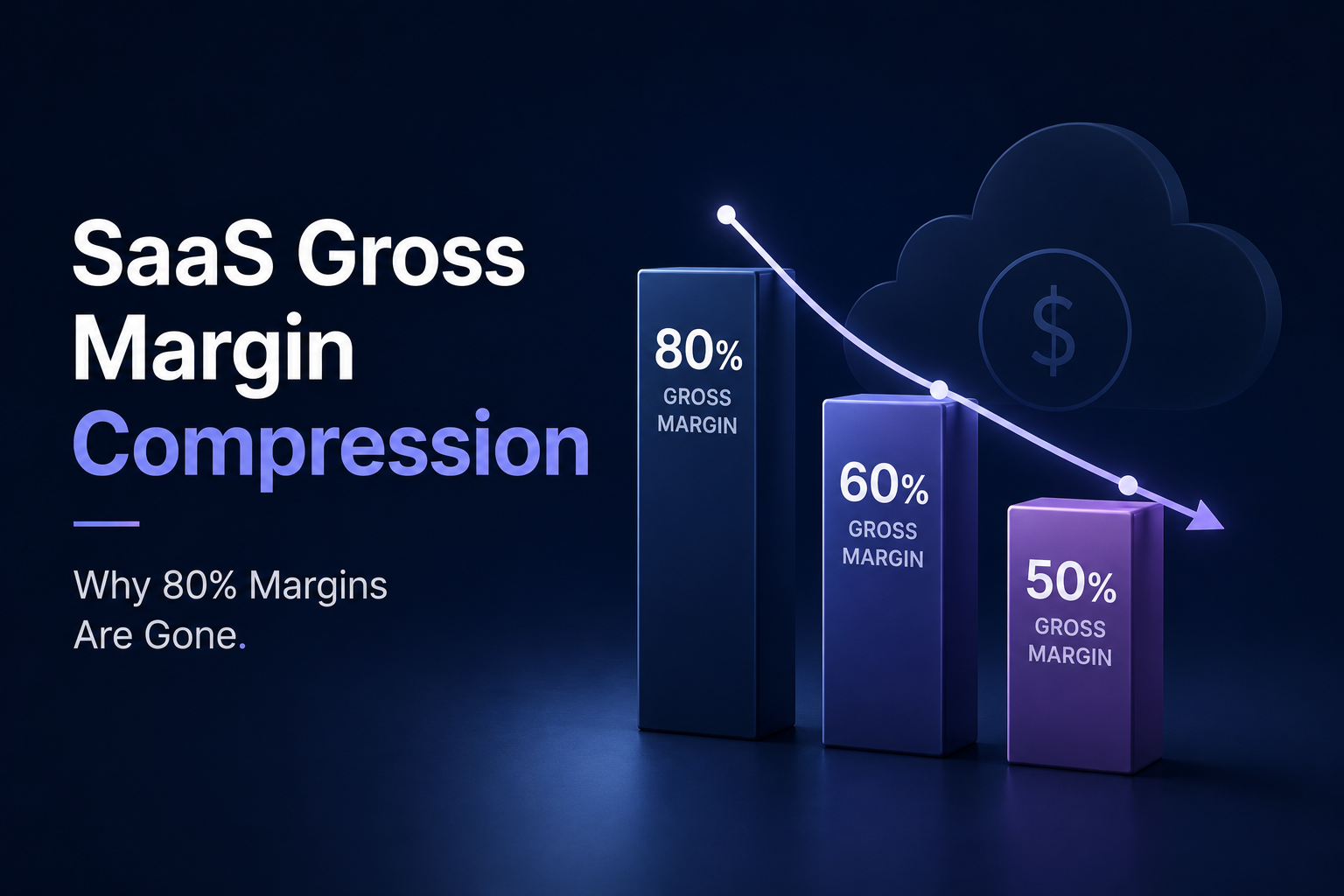
For twenty years, software had one financial superpower nothing else could copy. Building the product cost a fortune. Serving the next customer cost almost nothing. That single asymmetry produced eighty-percent gross margins, and everything the industry believed about valuation, growth spending, and sales hiring was built on top of it.
That assumption is being repriced in real time. Every AI feature shipped into a product converts a fixed cost into a variable one, because a model call consumes compute whether the customer is a Fortune 100 account or a trial user on a free plan.
SaaS gross margin compression is the structural decline in software gross margin that happens when AI inference, and the human delivery work surrounding it, move permanently into cost of goods sold.
The numbers arrived faster than most boards expected. Inference now averages roughly twenty-three percent of revenue at scaling AI-native companies, and it is not falling as those companies grow. ICONIQ’s 2026 survey put average AI product gross margin at fifty-two percent. Several public SaaS companies began breaking out inference cost separately in their filings this year, typically at four to nine percent of revenue, and multiple vertical SaaS businesses disclosed six to nine points of year-over-year gross margin compression with AI features named as the cause.
Eighty percent has not disappeared. It has become a category, not a default.
Key takeaways before the detail:
- Inference is typically only about a quarter of AI COGS; support, implementation, and evaluation headcount are the rest.
- Compute optimization stalls after roughly thirty to fifty percent, because the remaining calls are the valuable ones.
- Pricing and delivery structure, not infrastructure tuning, are where margin is genuinely recovered.
What Is SaaS Gross Margin Compression?
Gross margin is revenue minus the cost of delivering the product: hosting, infrastructure, support, customer success, implementation, and now model inference. Compression is what happens when that delivery cost grows faster than revenue.
The metric carries weight because it sets the ceiling on every other number in the business. A company at eighty percent keeps eighty cents of each new dollar to fund growth. A company at fifty-five percent keeps fifty-five. Same revenue, same growth rate, completely different company.
Three product profiles have emerged, and they price very differently:
- AI-augmented products, where AI is a light feature on top of conventional software, still target around eighty percent gross margin.
- AI-enabled products, where AI drives a meaningful share of usage, land between sixty and seventy-nine percent.
- AI-native products, where the model is the product, run at fifty to sixty percent.
The mistake is assuming a company gets to pick its profile. Customers decide it, by using the expensive features far more than anyone forecast.
Why Is Inference Only Half of the New COGS Line?
Most margin conversations stop at compute, because compute arrives as a bill with a number on it. The other half has no invoice and shows up as headcount.
AI features cost more to deliver than the software before them, and most of that extra cost is people, not GPUs. Evaluation, prompt and retrieval maintenance, model version testing, escalation paths for wrong output, implementation work to connect a customer’s messy data to a system that assumes clean inputs. Every one of those sits in cost of goods sold, not R&D. This is where otherwise disciplined companies quietly lose four or five points of margin, which is a large part of why nearshore staff augmentation has moved from a cost-saving tactic to a genuine margin strategy in AI-heavy SaaS companies.
The pattern is consistent. Teams manage cloud spend to the dollar, then staff the delivery side reactively with expensive senior hires in the highest-cost market they know, because the roadmap was already late. Efficient operators treat delivery capacity as a cost structure decision instead.
Timezone overlap matters more here than it used to. Evaluation and escalation work is collaborative and does not survive a twelve-hour handoff, while blended nearshore rates still land well below onshore equivalents. The result is lower cost to serve without pushing the work somewhere nobody can review it the same day.
Stated plainly: if model cost is fixed by physics and delivery cost is fixed by where you hired, only one of those two is still negotiable.
Why Does Cutting Inference Costs Hit a Floor?
The first instinct is engineering. Cache aggressively, route easy queries to smaller models, quantize, batch, fine-tune a cheap model to replace an expensive one. All of it works, and teams routinely remove thirty to fifty percent of inference spend in a quarter of focused effort.
Then it stops. The remaining calls are the ones customers actually value, which are the ones that need the strongest model. Optimize past that point and quality drops, which shows up as churn, which costs far more than the compute it saved.
Falling token prices do not rescue the model either. Per-token costs have dropped consistently while inference as a share of revenue has stayed flat or risen, because every price cut gets spent on more capable models, longer context, and reasoning that runs for thirty seconds instead of two. Cheaper units, more units.
Which means gross margin is not primarily an infrastructure problem. It is a pricing and delivery problem wearing an infrastructure costume.
How Does the Delivery Model Change Gross Margin?
Once cost to serve is visible per customer, the question stops being what to cut and becomes how the delivery organization should be shaped. It comes down to one choice: buy capacity and direct it yourself, or buy an outcome and let a partner own the operating cost of producing it. Working through a managed services vs staff augmentation decision guide before committing is worth the afternoon it takes, because reversing the choice eighteen months later costs a year of accumulated context.
The first option keeps control and institutional knowledge inside the company, and works best when the work is core to the product. The second converts a variable, unpredictable cost into a contracted one, and works best for functions that are essential but not differentiating: tier-one support, monitoring, routine maintenance.
The failure mode is applying one model to the entire delivery organization. Mature companies run both: augmented teams inside product and evaluation work where domain knowledge compounds, and managed arrangements around the operational surface that has to run reliably but never needed to be in-house.
Get this wrong and no amount of prompt caching closes the gap. Get it right and several points of margin appear without touching the product at all.
Why Per-Seat Pricing Is Now a Margin Problem
Per-seat pricing was designed for a world where the marginal cost of a seat was zero. It has become the single most common cause of margin compression, because a heavy user and a light user pay the same amount while consuming wildly different amounts of compute.
The correction is happening three ways. Hybrid pricing puts a platform fee alongside metered usage. Outcome pricing charges per resolved ticket, completed document, or closed case, aligning cost with value directly. Tiered model access lets customers choose the expensive tier and pay for it.
None of this is exotic. What makes it hard is that it requires knowing cost to serve per customer, and a surprising number of SaaS companies cannot produce that number. They know total cloud spend and total revenue. Ask which twenty accounts are unprofitable and the room goes quiet.
Instrument that first. Every pricing decision after it becomes obvious.
What Do the 2026 Gross Margin Benchmarks Show?
Bessemer Venture Partners, whose State of the Cloud research has anchored SaaS benchmarking for more than a decade, documents this shift in its AI pricing and monetization playbook. Their data puts AI company gross margins at fifty to sixty percent against the eighty to ninety percent traditional SaaS enjoyed, with vertical AI companies at meaningful scale averaging around sixty-five percent.
The more useful finding sits underneath the headline number. Model cost is often only about a quarter of total COGS at those companies. The other three quarters are infrastructure, support, and delivery, which is the portion a management team can actually restructure.
Investors have already adjusted. A seat-priced product at sixty-percent margin with rising usage is now a harder story to fund than a usage-priced product at the same margin, because in the second case growth pays for itself and in the first it does not.
How Do You Protect SaaS Gross Margin Without Weakening the Product?
The short answer: measure margin per customer, reprice before the compression shows up in reported numbers, and restructure delivery cost deliberately rather than cutting product quality. In practice, the companies handling this well do five specific things:
- Measure gross margin per product line and per customer segment, not only at company level.
- Treat inference optimization as a standing engineering commitment with a named owner, not a one-off project.
- Reprice early, since repricing under visible pressure signals weakness to customers and investors alike.
- Structure delivery and support capacity by cost and timezone instead of defaulting to local senior hires.
- Tell investors the margin story before investors discover it, which turns a surprise into a plan.
The last one is underrated. Compression disclosed with a roadmap attached reads as maturity. The same compression found in a diligence spreadsheet reads as a company that was not watching.
What This Changes About How SaaS Is Valued
Revenue multiples were always shorthand for gross profit multiples, and the shorthand worked while every software company shared roughly the same margin. It does not work anymore.
A dollar of revenue at fifty percent margin is worth meaningfully less than a dollar at eighty, and public and private markets are both re-rating accordingly. Expect gross margin to be diligenced with the intensity previously reserved for net revenue retention, and expect the question underneath it to be sharper than the number itself: is this margin structural, or is this a company that has not yet done the work?
Frequently Asked Questions (FAQ’s)
Q1. What is a good SaaS gross margin in 2026?
It depends on the product profile. AI-augmented software should still hold near eighty percent, AI-enabled products land between sixty and seventy-nine percent, and AI-native products typically run fifty to sixty percent. The right benchmark is the profile you actually operate, not the one on the pitch deck.
Q2. Is AI-driven gross margin compression temporary?
The evidence says no. Per-token prices keep falling while inference as a share of revenue stays flat, because savings are immediately reinvested in more capable models and longer context. The cost structure has changed permanently, even as individual unit costs continue to drop.
Q3. Does inference cost explain most of the margin decline?
Not usually. At many AI companies, model cost accounts for roughly a quarter of total COGS. Infrastructure, support, implementation, and evaluation work make up the rest, which is why delivery and staffing decisions often move gross margin more than compute optimization does.
Q4. What is the fastest way to improve SaaS gross margin?
Measure cost to serve per customer, then act on what it shows. The fastest wins usually come from repricing the heaviest accounts, routing low-value queries to smaller models, and restructuring where delivery and support capacity sits, in that order.
Q5. What belongs in SaaS cost of goods sold?
Hosting and infrastructure, third-party APIs and model inference, customer support and success, implementation and onboarding, and the engineering time spent keeping the service running. Product development aimed at future features stays in R&D, below the gross margin line.
Q6. How does gross margin affect SaaS valuation?
Revenue multiples assume a shared margin profile, so when margins diverge, the multiple follows gross profit rather than revenue. Two companies with identical ARR and growth can now be valued very differently, and investors increasingly diligence margin durability alongside net revenue retention.
Final Verdict
The eighty-percent gross margin was never a law of software. It was the consequence of one technical fact, that serving another customer cost almost nothing, and that fact no longer holds for products built on models.
What replaces it is less elegant and more familiar to every other industry: margin as something managed rather than inherited. Priced deliberately, instrumented per customer, and defended through where the work gets done and who does it.
Companies that treat this as an accounting inconvenience will keep shipping features and quietly funding them. The ones that treat it as an operating discipline will end up with the same product, a structurally better P&L, and a much easier conversation the next time someone opens the model.