Essential Accessories That Make an Automated Gate System Safer and More Convenient
A gate motor on its own is a gate motor. What makes it a complete access system is the accessories connected to it. The six accessories that matter most are safety photocell beams, a battery backup, a keypad or intercom panel, a loop detector, a warning light, and a wireless receiver with extra remote capacity. Each one solves a specific failure point that a bare motor kit cannot address. In Australia, photocell beams and an auto-reverse function are required under AS 5007 for any automated gate, which means some of these are not optional upgrades. They are compliance minimums.
The Gap Between a Gate Kit and a Gate System
Every gate motor kit ships with a motor, a control board, and a handful of remotes. That is enough to open and close your gate. It is not enough to make it safe, convenient, or compliant for everyone who uses it.
The accessories you add afterwards are what turn a motor kit into a system that works for tradespeople, visitors, deliveries, children near the driveway, and power outages on a January afternoon.
The right place to start is with electric sliding gate accessories that address the most common failure points in Australian residential and commercial gate systems.
Start with safety, then add convenience, then add redundancy. That order protects both the people using the gate and the motor running it.
Safety Photocell Beams: The Accessory You Cannot Skip
Photocell beams project an infrared signal across the gate opening. When something breaks the beam mid-cycle, the gate stops and reverses immediately.
Without photocell beams, the only protection a gate has is motor current sensing, which detects resistance after the gate has already made contact with whatever is in its path. That distinction matters when the thing in the path is a child, a dog, or a car door.
Under AS 5007, obstacle detection is mandatory for all automated gates in Australia. A force-sensing motor alone may meet the minimum requirement, but adding photocell beams creates a second layer that stops the gate before contact rather than after.
For any property with regular pedestrian traffic through the gate opening, photocell beams are the first accessory to add, not the last.
Battery Backup: The Accessory That Earns Its Cost in the First Storm
A gate motor without battery backup becomes a fixed barrier the moment the power goes out. In Australia, grid outages during summer storms, bushfire events, and high-demand days are common enough that a battery backup is not a luxury for most properties. It is basic operational continuity.
A 7Ah sealed lead-acid battery typically supports 50 to 80 gate cycles on a full charge with no solar input. For a family using the gate eight times daily, that covers two to three days of outage before the battery needs recharging.
Size up to a 12Ah battery if your property has high daily cycle counts or is in an area with a risk of extended outages. For solar-powered systems, the battery is included in the kit.
For mains-powered systems, adding a backup battery takes under 30 minutes and costs $40 to $90.
Keypads and Intercom Panels: Access for Everyone Without a Remote
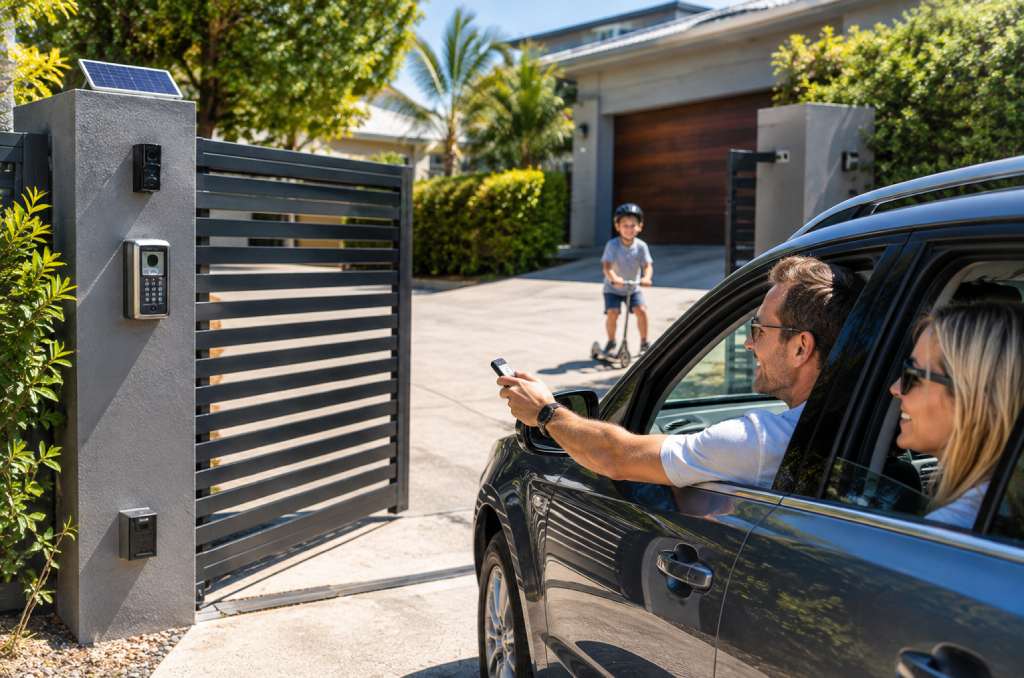
A keypad gives anyone with the code access to the property without needing a programmed remote. That matters for tradespeople, cleaners, regular visitors, and delivery services.
A keypad code can be issued temporarily and changed instantly when access is no longer needed, whereas a physical remote cannot be changed without reprogramming the entire receiver.
An intercom panel provides a two-way audio connection, allowing visitors to announce themselves before the gate opens.
Video intercom panels provide a camera view of the gate entry and integrate with most modern smart home systems.
For rental properties, Airbnb accommodations, and any site where access management changes regularly, a keypad or intercom replaces the need to distribute and recover physical remotes with a system that remains manageable over time.
Loop Detectors: The Accessory That Keeps the Gate From Closing on Your Car
A loop detector is a wire loop embedded in the driveway surface that detects the presence of a vehicle directly under or approaching the gate.
When a vehicle sits on the loop, the gate holds open. When the vehicle clears the loop, the timer-to-close sequence begins.
Without a loop detector, a gate with an auto-close timer can close on a slow-moving vehicle, a trailer, or a second car following closely through the entry.
Loop detectors are standard on commercial sites and busy residential driveways. They are worth adding to any residential property where vehicles frequently queue at the gate opening or where a reversing vehicle might obstruct the gate.
The installation requires cutting a channel in the driveway surface, which is a job for a professional installer, but the detector unit itself costs $80 to $150 for most Australian-compatible models.
Warning Lights and Horns: The Accessory That Protects Bystanders
A warning light or horn signals that the gate is about to move. This matters in any situation where a person approaching on foot may not have a clear line of sight to the gate before it starts moving.
Commercial properties, shared driveways, and gates close to a public footpath all benefit from a visual or audio warning before each cycle.
A flashing amber beacon mounted above the gate motor housing costs $30 to $80 and wires directly into the control board’s auxiliary output. Most control boards in Australian gate kits include a terminal for a warning light as standard.
A combined light and buzzer unit provides an audio warning at sites where a visual signal alone is not sufficient. Both options add a layer of bystander safety that a bare motor kit lacks.
A gate motor is the mechanism. The accessories are what make it a system that the people around it can trust.