The Best App Localization Solutions in 2026: A Buyer’s Guide for Mobile Product Teams
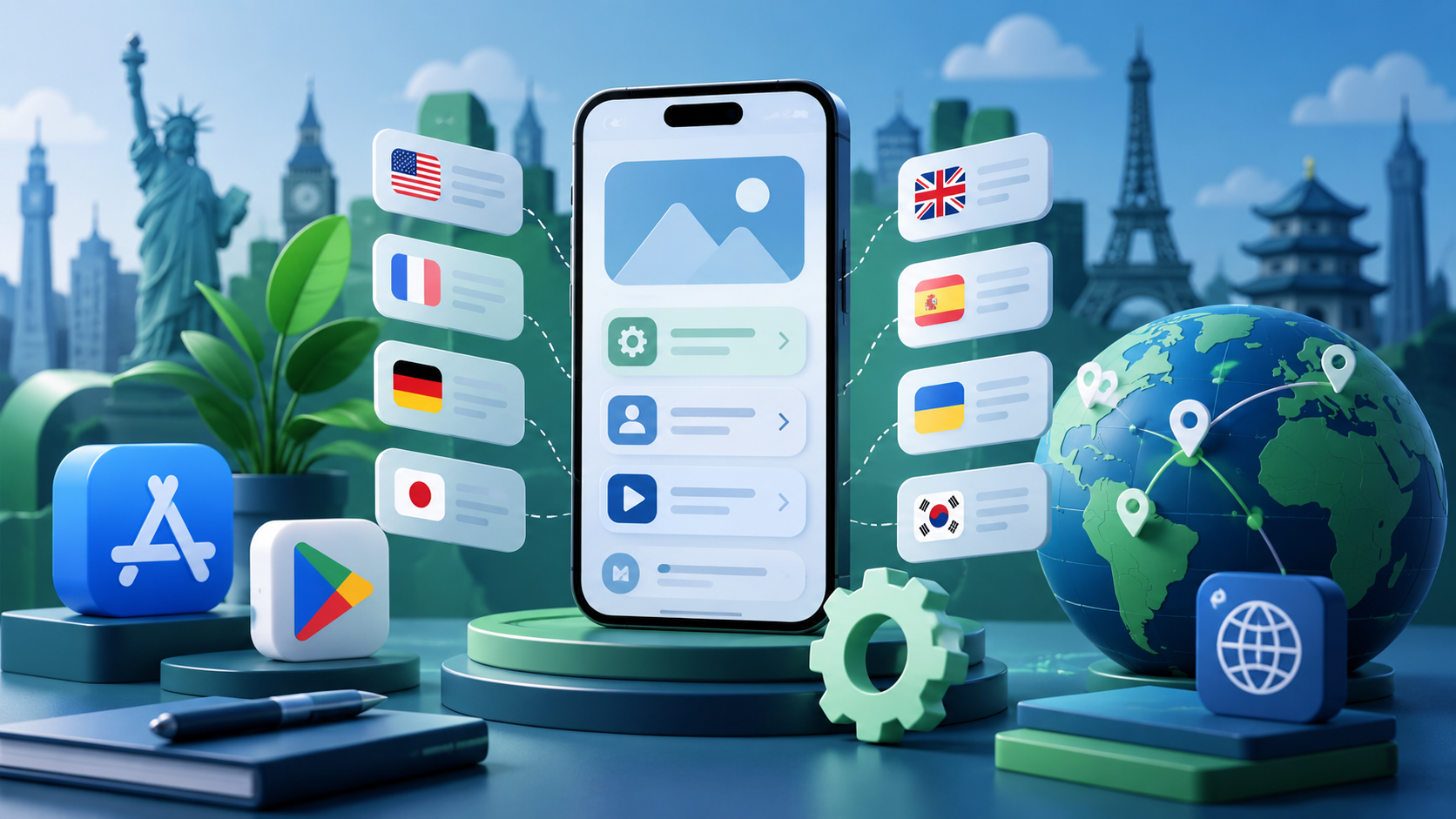
Key Takeaway: The best app localization solution matches your team’s platform stack (iOS, Android, Flutter, React Native), content volume, and release cadence — not the vendor with the loudest marketing. Eight platforms consistently deliver production-grade mobile localization in 2026, each with different strengths worth evaluating in a structured pilot.
TL;DR: The best app localization solutions in 2026 combine neural machine translation, translation memory, glossary management, in-context editing, native mobile SDKs, and over-the-air translation delivery into managed platforms. Crowdin, Lokalise, Phrase, Smartling, POEditor, Transifex, Applanga, and Smartcat each fit different operational profiles — from indie developers using free tiers to enterprises spending six figures per year. The right choice depends on team size, target languages, engine integration needs, voice-over scope, and how deeply localization sits in the product development cycle.
Mobile apps in 2026 operate in more languages, more markets, and more regulatory environments than at any point in history. App Store and Google Play rankings reward localized listings with higher visibility, retention curves in non-English markets bend sharply upward when the app speaks the user’s language, and entire categories of mobile apps — fintech, health, education, gaming — depend on regional adaptation to function at all.
Yet the tooling that makes serious mobile localization possible varies dramatically across vendors. What used to be a market of generalist translation agencies has become a specialized industry with platforms, mobile SDKs, over-the-air delivery, engine integrations, and continuous localization workflows. Choosing among the current leaders requires more than a feature comparison — it requires matching operational profile to platform architecture.
This guide profiles the eight most capable app localization solutions available in 2026, describes what they do as managed services, and provides a framework for matching your team’s requirements to the right vendor. Structured pilots on real production content consistently outperform proposal comparisons, so the goal here is to shortlist candidates rather than to pick a single winner that fits every team.
What Makes a Great App Localization Solution
Modern app localization platforms deliver an integrated stack of capabilities that would take engineering teams a year or more to reproduce internally. The essential components include:
- Native mobile file format parsing — iOS .strings and .stringsdict, Android XML, Flutter .arb, React Native JSON
- Multiple neural machine translation engines with automatic routing per content type
- Translation memory that compounds value across releases
- Glossary and terminology management for brand-consistent terms
- In-context editing so translators see strings in the actual mobile UI
- Over-the-air translation delivery for updating live apps without new binaries
- Native SDK integration with iOS, Android, and cross-platform frameworks
- Continuous integration with GitHub, GitLab, Bitbucket, and CI/CD pipelines
- Human review workflows scoped by content sensitivity
A great solution combines all of these into a single managed service. A mediocre solution offers a subset and forces the team to bridge gaps with custom scripting or manual coordination — which typically breaks by the third supported language.
Top 8 App Localization Solutions in 2026
1. Crowdin
Delivered as a managed service, Crowdin’s app localization service packages multiple neural translation engines, translation memory, glossary management, in-context editing, and continuous integration workflows into a single platform. It supports iOS, Android, Flutter, React Native, and Xamarin natively, with over-the-air translation delivery and integrations spanning GitHub, GitLab, Bitbucket, Figma, and Zendesk.
Best fit: teams shipping in multiple languages on continuous release cadences, from indie developers using the free tier to large enterprises on managed contracts. Enterprise plans include SSO, audit logs, dedicated support, and SLA guarantees.
2. Lokalise
Lokalise is a developer-friendly translation management system focused on SaaS and mobile-first teams. It offers Git integration, branching workflows that mirror code branches, and mobile SDKs for iOS, Android, React Native, and Flutter. Lokalise OTA pushes translations to live mobile apps without store resubmission.
Best fit: mid-market SaaS and mobile teams that prioritize workflow polish and tight integration with mobile build systems. Enterprise tiers include SAML SSO, role-based access, and SOC 2 Type II compliance.
3. Phrase
Phrase, formed through the merger of Phrase Strings and Memsource, combines developer-facing string management with a full translation management system inherited from Memsource. It embeds AI throughout — automatic engine selection, AI-driven quality estimation, and machine translation customization through its NextMT engine.
Best fit: enterprises with diverse content needs beyond mobile strings — marketing, support, and legal content that benefit from operating within a single ecosystem.
4. Smartling
Smartling sits at the enterprise end of the market. Its NeuralTranslate engine learns from customer-specific translation memory over time, and the platform pairs with a vetted translator network for managed language services. Visual context tools show translators exactly where strings appear.
Best fit: global brands with strict consistency requirements across mobile, marketing, e-commerce, and customer experience content. Higher price point requires substantial project volume to justify.
5. POEditor
POEditor occupies the accessible end of the mobile translation market. It handles all major mobile and web file formats, offers a clean web editor, supports machine translation through multiple engines, and integrates with GitHub, GitLab, Bitbucket, and Slack. Its pricing is among the most accessible in the industry.
Best fit: indie developers and small studios needing professional-grade mobile localization without enterprise complexity or cost. Genuine free tier supports small projects.
6. Transifex
Transifex has been a fixture in the localization space for years, with particular strength in community-driven and open-source translation projects. It supports the standard mobile file formats, offers Git integration, and provides a competent web editor for translators.
Best fit: teams mixing commercial and open-source mobile content, or projects with active community translator bases that contribute alongside professional translators.
7. Applanga
Applanga is a mobile-first platform built around over-the-air translation updates. Deep iOS and Android SDK integration lets developers push translation changes to live apps in real time and A/B test alternative translations directly in production without going through app store review.
Best fit: mobile teams that iterate rapidly and want live translation experimentation. Purpose-built for mobile apps but does not extend gracefully into web or marketing localization.
8. Smartcat
Smartcat has positioned itself as an AI-first localization platform that bundles a translation editor, translator marketplace, payment processing, and multi-engine machine translation into a single environment. Consumption-based pricing suits mobile teams with variable translation volume.
Best fit: enterprises consolidating multiple vendors into a single platform, particularly when the same team handles mobile strings, marketing content, and support material.
How to Choose the Right App Localization Solution
Selecting among these eight platforms comes down to a few honest questions about scale, technical stack, and workflow fit:
- Small teams shipping in 3-5 languages: Crowdin, Lokalise, or POEditor — all offer accessible entry tiers with mobile-native support
- Mid-market teams shipping in 5-15 languages continuously: Crowdin, Lokalise, or Phrase provide strong workflow tooling and integrations
- Enterprise teams with strict compliance and 15+ languages: Smartling or the enterprise tiers of Crowdin and Phrase
- Teams prioritizing over-the-air delivery: Applanga, Lokalise, and Crowdin lead in this capability
- Teams consolidating multiple vendors: Smartcat offers a marketplace-plus-editor consolidation model
Beyond feature comparisons, the strongest predictor of success is workflow fit. A platform aligned with how your team already ships code — its Git workflow, CI/CD setup, release cadence — delivers value within weeks. A platform that fights those patterns, regardless of feature strength, will sit underused within a quarter.
The best evaluation approach is a two-week paid pilot on real production content. Shortlist three platforms, run them in parallel on the same content, and judge by operational fit rather than sales presentation quality. Vendors that resist paid pilots are almost always the wrong choice.
Best Practices for App Localization Success
Regardless of which platform you choose, certain practices separate teams that ship high-quality international releases from those that struggle:
- Externalize strings before adding new features — retrofitting internationalization into a mature codebase is exponentially more expensive
- Own your translation memory in portable formats (TMX, TBX) — never let language assets live only with vendors
- Route content by quality requirement — high-stakes content deserves human review; routine content can flow through AI with automated QA
- Include LQA as a mandatory release gate — even a two-week pass on main flows catches most launch-day disasters
- Track per-locale metrics — aggregate translation cost and quality hide language-specific inefficiencies
- Test with pseudo-localization in CI — cheapest way to catch layout bugs before real translation begins
- Version glossary and terminology across releases — brand consistency depends on disciplined terminology enforcement
Frequently Asked Questions
What is app localization?
App localization is the process of adapting a mobile application for specific markets — translating text, adjusting UI for different scripts and text lengths, handling locale-specific formatting, and adapting cultural elements. It goes beyond translation to include everything that makes an app feel native to users in each target region.
How much does professional app localization cost?
Costs vary by app size and language count. Small mobile apps with 5,000-15,000 words typically budget $500-$3,000 per language for text-only translation. Larger apps with 30,000+ words and voice-over needs can spend $10,000+ per language. Machine translation with human post-editing reduces costs significantly for routine content.
What file formats do app localization platforms support?
The major platforms support iOS .strings and .stringsdict, XLIFF, Android XML resources, Flutter .arb, React Native JSON, and Xamarin .resx. Most also handle custom formats through parsers for less common frameworks.
What is over-the-air translation delivery?
Over-the-air (OTA) translation lets apps update translated strings without submitting a new binary through the App Store or Google Play. This dramatically shortens fix-to-live time for translation corrections and enables A/B testing translation variants directly in production.
Can AI translation handle app localization completely?
Not entirely. AI handles routine content — UI strings, help articles, item descriptions — with high accuracy. Character dialogue, marketing copy, and culturally sensitive material still benefit substantially from human translators. The dominant 2026 model is AI-first drafting with human review on flagged segments.
Which languages should mobile developers prioritize first?
The five languages with consistently strong ROI for mobile apps are Simplified Chinese, Brazilian Portuguese, Latin American Spanish, Russian, and German. Japanese and French follow closely for content-heavy apps. Priorities shift based on app category — fintech skews European, gaming skews Asian.
Conclusion
The market for app localization solutions in 2026 offers legitimate differentiation across eight strong vendors. Crowdin, Lokalise, Phrase, Smartling, POEditor, Transifex, Applanga, and Smartcat each fit different operational profiles. The right choice depends on team size, content types, target languages, and technical stack — not on vendor rankings that assume every team has identical needs.
Enterprises that treat platform selection as infrastructure planning rather than procurement build partnerships that support them across multiple releases. Those that treat it as a checkbox regret the choice within a year. Structured pilots, honest evaluation criteria, and contractual translation memory ownership are the three factors that separate successful vendor decisions from expensive mistakes.
For a broader perspective on the mobile app market that shapes localization priorities in 2026, Statista publishes regular data on mobile app downloads, revenue distribution across regions, and category-specific growth patterns. Its market research is one of the most cited independent sources on how the global mobile ecosystem continues to evolve, and its coverage complements the tool-specific analysis in this guide with the demand-side data that helps product teams prioritize which languages actually deliver the strongest returns on localization investment.