How Can a Scrum Master Use AI as a Force Multiplier Without Losing Human Judgment and Coaching Impact?
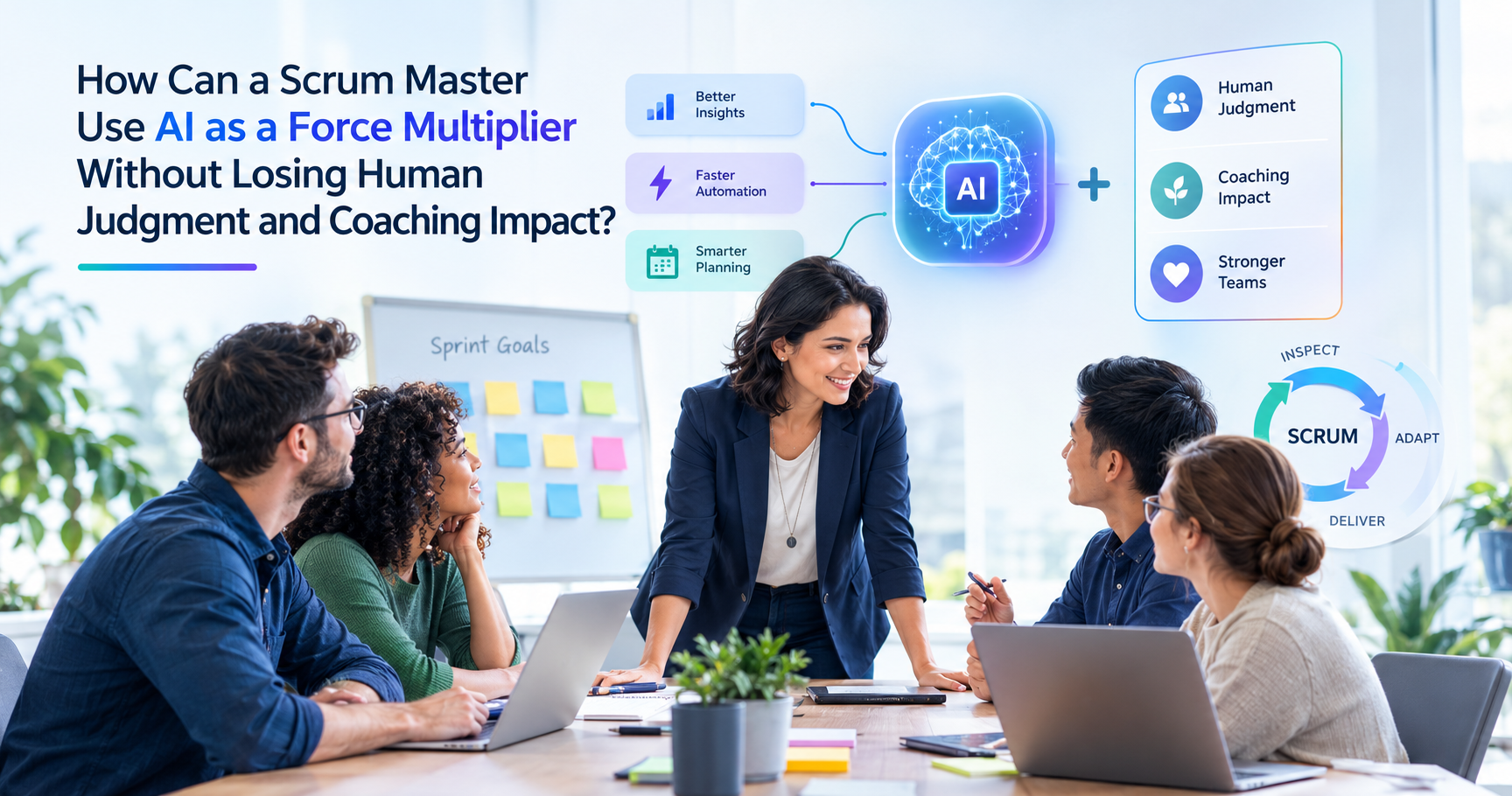
AI can generate a sprint summary in minutes, so why not use it to draft retrospective agendas, stakeholder updates, and coaching notes as well? Because saving time and creating impact are not the same thing. A team improves when someone helps it see itself clearly, facilitates honest conversations, and guides better decisions, not simply because its notes are well organized. This article introduces a practical three-lane model to help you decide what AI can handle, where AI can assist you, and what must remain your responsibility as a Scrum Master. Whether you are an experienced Scrum Master or preparing to enter the role, this is the right time to earn your CSM certification today and strengthen the human skills AI cannot replace.
What Does “AI as a Force Multiplier” Mean for a Scrum Master?
It’s about leveraging AI as an amplifier of your work, rather than a replacement of your work. The Scrum Master who can use AI to do preparation and paperwork will have more time available for coaching, facilitating, and removing barriers; this is when the Scrum Master provides the greatest value.
The multiplier effect works in two ways. Good facilitation results in better team discussions. Bad habits (for example, not checking in with each other individually) result in quicker avoidance.
The Three-Lane Model: Automate, Augment, Own
Sort every recurring task into one of three lanes.
| Parameters | AI’s role | Your role | Examples |
| Automate | Does the task | Spot-check | Meeting notes, scheduling, report formatting, tagging stale backlog items |
| Augment | Drafts or analyzes | Decide and personalize | Retrospective themes, stakeholder updates, sprint trend analysis, coaching prep questions |
| Own | Stays out or plays a minimal part | Lead | Conflict mediation, psychological safety, sensitive one-to-ones, team agreements, decisions about data use |
Conflict mediation, psychological safety, sensitive one-to-one discussions, team agreements, and decisions regarding the use of data.
Most of the work you do will go into the Augment lane. That is when you can expect to make errors. When you use the AI to generate something for the first time, you should consider it a “first draft” created by a very capable person who has never worked with your team.
Three Situations Where the Lanes Matter
The above are examples, not case studies, of situations that Scrum Masters encounter on a regular basis.
The daily scrum that has become stale. An AI will give us a summary of the last 14 days of updates and tell us that the exact same issue was reported 5 times. That’s good. But the reason no one reported the issue is a human issue: fear of reporting an issue, lack of clarity as to who can report an issue, or simply exhaustion. To determine which is true, we ask.
I noticed a teammate, who had submitted no written feedback, looking uncomfortable as we discussed the amount of work being done. We used the themes identified by the AI to start our conversation, and I followed-up privately after.
The stakeholder wants to know why velocity went down. AI can create a clear explanation based on the data. You have control over how much context you provide, whether or not velocity is the most appropriate way to assess progress, and how to avoid having your team evaluated by just one metric.
Five Judgment Checkpoints Before You Act on AI Output
Run any AI-generated insight through these questions:
- Is it accurate? Compare it with what you have observed.
- Is it complete? Ask what context the tool could not see.
- Is it fair? Check that it does not single out individuals unfairly.
- Is it safe to share? Confirm it contains no confidential or personal data.
- Would I say this to the team’s face? If not, rewrite it.
If any answer is no, revise before the output goes anywhere.
A Simple 30-Day Plan
Week 1: Audit your sprint tasks and place each in a lane.
Week 2: Begin automating a single, low-risk process, for example, creating meeting minutes. Review the results daily.
Week 3: Add to one activity (e.g., preparation for retrospective). Let your team know what tool you are using and the information that this tool is seeing.
Week 4: Find out from your team at the retrospective if the changes you made helped them save time, improve their work’s quality, or had an effect on how much they trust you. Based on what they tell you, make adjustments.
Common Mistakes That Quietly Erode Coaching Impact
Retrospect writing. When AI writes every retrospective question, you cease to practice the skill that enables you to be successful.
Turning measurement into surveillance. People will typically “play” to their dashboards when they are being tracked individually.
Hiding the tools. Secrecy damages trust faster than any tool can repair it.
In a world where the number of roles in this field is decreasing, beginners can be worried about how many roles will remain. As there is less time spent on administrative tasks, there may be more opportunities for coaches to work with their teams.
Using AI with strong emotions. A conflict, a lack of confidence, and making choices about an individual’s welfare require a person.
When Does Certification Make Sense?
The ability to coach and judge is something that can be taught. However, having a structured approach to learning these skills makes it much simpler to learn them. A Certified Scrum Master (CSM) class typically includes training on the Scrum framework, roles/accountabilities, events/activities, and the facilitation mindset; this is usually accomplished via instructor-facilitated training activities followed by a written examination. This type of training is appropriate for individuals new to the profession, project managers and business analysts who are transitioning into Scrum Master positions, and current Scrum Masters who wish to formally document their knowledge.
While some people find value in pursuing a Scrum Master credential, it is not always necessary. If you are an experienced Scrum Master who has had many opportunities to facilitate effectively, then focusing on improving your coaching skills will likely be of greater benefit to you than acquiring an additional certification.
When looking at different SSM certification courses or any other type of Scrum Master path you can take, consider the following:
- How well the certifying body is recognized in your target market
- The trainer’s hands-on Scrum experience
- The balance between practice and lecture
- Whether AI-assisted workflows are discussed
- What support exists after the course?
Learners typically research and evaluate several different providers of education/training programs (such as Simpliaxis) as part of their evaluation process of potential providers.
Next Step: Earn Your CSM Certification Today
If you wish to develop these abilities systematically, you may obtain your CSM certification at this time by enrolling in a program that focuses on facilitating, coaching, and practicing. Most effective programs will return you to your team with practical methods that you can immediately apply during your next sprint.
Conclusion
AI is most useful for a Scrum Master when handling the mundane aspects of Scrum Mastering, helping with the analysis, and remaining uninvolved in the personal dynamics of team members. To ensure you maintain the ability to make good decisions as well as provide visible coaching to your team, use the three-lane approach to categorize your work, complete the five-checkpoint process, and be open about your actions with your team.
Become a certified Scrum Master (CSM) today to make that approach a permanent skill, and practice it with your team. Tools will evolve over time; however, the ability to create relationships based on trust and lead teams will never change.