The 20% Shift: How ChatGPT Search Is Stealing Google Traffic
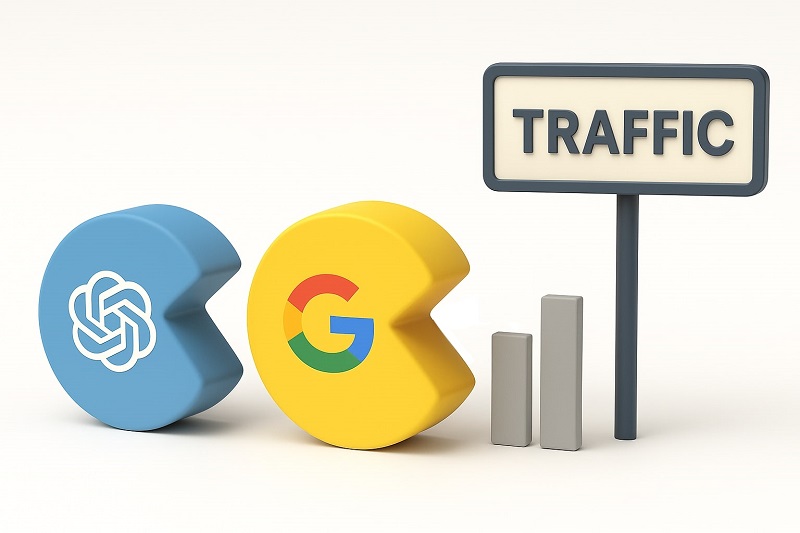
ChatGPT search is not replacing Google yet, but it is taking a real slice of the questions people used to type into Google. In November 2026, OpenAI said ChatGPT’s search volume is now about 20% of Google’s. Websites that only optimize for Google are now missing part of their audience.
In this article
- What Did OpenAI Actually Say About the 20% Figure?
- Is ChatGPT Really 20% of Google? The Honest Answer
- How Is ChatGPT Search Taking Traffic From Google?
- Key Terms Every Site Owner Should Understand
- Which Websites Lose the Most Google Traffic?
- What Does the 20% Shift Mean for Pakistani Websites?
- How Do You Get Your Site Into ChatGPT Search Answers?
- How Do You Track ChatGPT Search Traffic in GA4?
- Is Your Robots.txt Blocking ChatGPT Search?
- Frequently Asked Questions
- Start Winning ChatGPT Search Traffic Now
Picture a small business owner in Lahore who needs a new accountant. Five years ago, she would have typed “best accountant in Gulberg” into Google, opened three websites, and called one of them. Today, she opens ChatGPT and asks: “Which accountants in Gulberg handle FBR tax filing for small shops, and what do they charge?” ChatGPT searches the web, reads several pages, and gives her a short list. She might never visit Google at all.
That is the ChatGPT search traffic shift in one example. It is no longer a theory. The questions that used to belong to Google are now split between Google and AI tools. If your website is not showing up in those AI answers, part of your future traffic is already going to your competitors. In this guide, the team at Pak SEO Training explains what the 20% number really means, who is losing traffic, and the exact steps to get your website cited in ChatGPT search.
What Did OpenAI Actually Say About the 20% Figure?
In early November 2026, Adam Fry, OpenAI’s consumer product lead for ChatGPT, said at a press event that ChatGPT’s search volume is now “roughly one-fifth (20%) of the volume of queries of Google”. The comment came from an interview with Alex Kantrowitz, published by Big Technology on November 3, 2026, and it was reported the next day by Search Engine Roundtable.
OpenAI shared other numbers at the same event:
- ChatGPT grew from 1 billion to 1.2 billion weekly active users in about 60 days.
- That is 200 million new weekly users in two months.
- ChatGPT’s voice features now reach 250 million weekly users.
For comparison, Microsoft CEO Satya Nadella said during Google’s 2023 antitrust trial that Bing had only about 3% market share after more than ten years of trying. ChatGPT search launched only about two years ago.
ChatGPT search reached a fifth of Google’s query volume in about two years. Bing never got close.
Is ChatGPT Really 20% of Google? The Honest Answer
The number is real, but it is OpenAI’s own claim, and how it is measured matters. A good SEO decision needs the full picture, so here are the caveats.
How Does OpenAI Count a “Search”?
Fry explained that ChatGPT counts a search whenever a question makes ChatGPT go out to the web. One 20-message conversation could count as several searches, or as none at all. OpenAI also did not say where its Google figure came from, so the 20% cannot be checked independently. Several analysts call it a company claim rather than a measured market share.
What Do Independent Studies Show?
Other studies come to very different answers depending on what they measure:
- Graphite found that ChatGPT accounts for about 20% of search-related traffic worldwide and about 12% in the US.
- SparkToro and Datos used a stricter clickstream method that counts only “search-like” prompts. By that method, Google still handles about 373 times more search queries than ChatGPT.
- Another independent study found that ChatGPT sessions equal just 0.62% of Google’s organic search sessions. That is a different metric from OpenAI’s query volume.
- Google says it processes about 5 trillion searches a year.
Key insight: The 20% figure measures how much people use ChatGPT’s search feature. It does not mean 20% of Google’s users have left. Most people now use both tools, often for the same task.
How Is ChatGPT Search Taking Traffic From Google?
“Stealing” is a strong word, but for many websites it is an accurate description. The traffic loss happens in three ways.
1. Fewer Google Searches Per Task
Datos and SparkToro’s Q4 2025 State of Search report found that Google searches per US user fell about 20% year over year. People did not leave Google. They just needed fewer searches to finish each task, because AI summaries answered more of their questions at once. Fewer searches means fewer chances for your page to be clicked.
2. Research Questions Move to ChatGPT
Long, complex questions are where ChatGPT does best: “compare X and Y,” “plan this for me,” “explain this in simple words.” These used to be valuable Google searches that sent visitors to blogs and guides. Now ChatGPT reads those blogs and writes the answer itself. The user gets the information, but the blog may not get the visit.
3. Google Itself Is Keeping More Clicks
Google is responding by putting more AI on its own results page. AI Mode had more than 1 billion monthly US users by May 2026, and Google now shows up to four ads in AI Mode. In one publisher’s case, the Daily Mail’s own data showed mobile click-through rate dropping from about 20% to 7% when an AI Overview appeared. So the pressure on organic clicks comes from both ChatGPT and Google.
The traffic is not disappearing. It is moving to places where an AI answers first and links second.
But Traffic Also Flows Back to Google
It is not all one-way. Semrush research showed that about 20% of ChatGPT’s referral traffic went back into Google. Many users discover a brand in ChatGPT, then search for that brand on Google to check it. That means brands visible in both places win twice.
Key Terms Every Site Owner Should Understand
- ChatGPT search: The feature that lets ChatGPT search the live web and show answers with source links, instead of only using its training data.
- Citation: A link or source mention that ChatGPT shows beside its answer. A citation is the new “ranking position.”
- GEO (Generative Engine Optimization): Optimizing your content so AI tools like ChatGPT, Gemini and Perplexity choose to quote and cite it.
- Zero-click search: A search where the user gets the answer on the results page or in the AI chat and never visits a website.
- Referral traffic: Visitors who arrive by clicking a link on another site. ChatGPT visitors usually show up in analytics as referrals from chatgpt.com.
- OAI-SearchBot: OpenAI’s crawler that finds and reads web pages for ChatGPT search results.
Which Websites Lose the Most Google Traffic?
Not every site is hit equally. Based on how ChatGPT answers questions, these types of content are most at risk:
- Simple “what is” and definition pages: ChatGPT answers these in two lines, so there is little reason to click.
- Generic how-to guides: If 50 blogs say the same thing, ChatGPT can merge all of them into one answer.
- Comparison and “best of” lists without real testing: AI can build these lists itself.
- Thin, rewritten news: If you only rewrite other people’s news, AI tools quote the original source instead.
Content that is safer and still gets clicks:
- Original data, surveys and case studies with real numbers
- Local information AI cannot easily guess (prices in Lahore, office timings, local rules)
- Tools, calculators and checkers people must use on your site
- Expert opinion with a real name, real experience and a clear point of view
- Services and products, where the user must contact or buy from you
Example: A blog post titled “What is a backlink?” will lose most of its clicks to AI answers. A post titled “We built 300 backlinks for Pakistani e-commerce stores: here is what moved rankings” contains data no AI can make up. ChatGPT has to cite it.
What Does the 20% Shift Mean for Pakistani Websites?
For Pakistani website owners, bloggers and agencies, this shift is both a threat and an opening.
The Threat
Many Pakistani blogs grew on informational Google traffic: tech tips, “how to” guides, net worth posts and general knowledge. That kind of traffic is exactly what AI answers absorb first. If most of your visitors come from simple questions, expect slow, steady drops even when your Google rankings look the same.
The Opening
Very few Pakistani businesses are optimizing for AI answers yet. When someone asks ChatGPT “best SEO course in Lahore” or “reliable guest post service in Pakistan,” the AI has a small pool of trusted local sources to pick from. Getting into that pool now, while competition is low, is much easier than it will be in two years.
Example: Think of two Karachi furniture shops. Shop A has a basic website with a contact number. Shop B has a page listing real price ranges, delivery areas, wood types and customer questions, plus reviews on Google and mentions in local blogs. When a buyer asks ChatGPT “where to buy a sheesham bed in Karachi under 80,000,” Shop B gives the AI something to quote. Shop A does not.
Quick win this week: Open ChatGPT and ask 5 questions your customers would ask, such as “best [your service] in [your city]”. Note which websites get cited. Those are your real AI competitors. Study what their pages have that yours do not.
How Do You Get Your Site Into ChatGPT Search Answers?
The good news is that most of this is solid SEO done properly. Here is what matters most.
Answer the Question in the First 2 to 3 Lines
AI tools pull short, clear answers. Start every article with a direct answer to the main question, then explain in detail. If your answer is buried under 300 words of introduction, ChatGPT will pick a page that answers faster.
Use Question Headings
Write your H2 and H3 headings as the questions people actually ask, like “How much does SEO cost in Pakistan?” Each section should answer one question completely. This makes it easy for AI to lift the exact part it needs.
Add Numbers, Dates and Specifics
“SEO takes time” gives the AI nothing to quote. “Most new sites in our projects saw first page-one rankings in 3 to 6 months” does. Specific numbers, prices, timelines and steps make your content more quotable.
Build Brand Mentions, Not Just Links
ChatGPT forms its view of a brand from what the whole web says about it. Mentions on trusted, relevant sites, positive reviews, directory listings and social profiles all help. For example, an expert quote or feature on a general-interest publication such as Magazine Reader places your brand name in exactly the kind of content AI tools read when they build an answer. Quality link building on relevant sites still matters too, because the same pages that send links also teach AI tools who you are.
Make Sure Bing Can See You
ChatGPT search draws on third-party search providers, and it is widely reported to use Bing’s index. Many Pakistani site owners never open Bing Webmaster Tools. Verify your site there, submit your sitemap, and use IndexNow so new pages are found quickly.
Keep Pages Fresh
AI search prefers current information. Update key pages with a visible “last updated” date, new figures and new examples at least every 3 to 6 months.
How Do You Track ChatGPT Search Traffic in GA4?
You cannot improve what you do not measure. By default, GA4 mixes AI visitors in with ordinary referrals. Here is how to separate them in about 10 minutes:
- In GA4, go to Admin → Data display → Channel groups.
- Create a new channel group and add a channel named “AI Search”.
- Set the condition to Source matches regex: chatgpt\.com|openai\.com|perplexity\.ai|gemini\.google\.com|copilot\.microsoft\.com|claude\.ai
- Drag the AI Search channel above the Referral channel so it is checked first.
- Save, then view Reports → Acquisition → Traffic acquisition with your new channel group.
ChatGPT usually adds utm_source=chatgpt.com to the links it shows, which makes these visits easier to spot. Also check the AI performance report in Google Search Console, which Google added in September 2026, to see how your site performs in Google’s own AI features.
Example: After setting this up, a Pakistani tech blog might find that AI search sends only 2% of its visitors, but those visitors stay twice as long and convert better. AI visitors usually arrive after reading a summary, so they come with stronger intent.
Is Your Robots.txt Blocking ChatGPT Search?
This is the niche fix most site owners miss. Some security plugins, firewalls and hosting setups block AI crawlers by default. If OAI-SearchBot is blocked, ChatGPT search cannot read your pages, so it cannot cite them.
Open yourdomain.com/robots.txt and make sure you are not blocking it. A safe setup looks like this:
User-agent: OAI-SearchBot
Allow: /
User-agent: Bingbot
Allow: /
Note the difference: OAI-SearchBot is used for ChatGPT search results, while GPTBot collects data for training OpenAI’s models. You can block GPTBot if you do not want your content used for training and still allow OAI-SearchBot so you appear in search answers. Also check Cloudflare’s bot settings, because its AI-crawler blocking can override your robots.txt.
A single line in robots.txt can make your website invisible to ChatGPT search. Check it today.
Frequently Asked Questions
Is ChatGPT search replacing Google?
No. Google still processes trillions of searches a year and remains the biggest traffic source for most websites. ChatGPT is growing alongside Google, and many users use both. But ChatGPT is taking more and more research-type questions.
Who said ChatGPT search is 20% of Google?
Adam Fry, OpenAI’s consumer product lead for ChatGPT, in early November 2026. The figure is OpenAI’s own claim and has not been independently verified.
Does ChatGPT send real traffic to websites?
Yes, through the source links it shows in answers. The volume is still small compared to Google for most sites, but the visitors often have strong intent.
How long does it take to appear in ChatGPT answers?
If your pages are indexed by Bing and not blocked, updated content can start appearing in ChatGPT search within days to a few weeks. Building enough brand trust to be recommended for competitive queries usually takes 3 to 6 months of consistent work.
Should Pakistani small businesses care about ChatGPT search?
Yes, especially service businesses. Customers increasingly ask AI tools for local recommendations, and very few Pakistani businesses are optimized for it yet, so early movers have an advantage.
Start Winning ChatGPT Search Traffic Now
The 20% shift is a signal that search no longer belongs to one platform. Google still matters most, but ChatGPT search traffic is growing fast, and the websites that adapt early will hold their ground. Use this action list:
- Check robots.txt and Cloudflare: Make sure OAI-SearchBot and Bingbot are allowed.
- Verify your site in Bing Webmaster Tools: Submit your sitemap and turn on IndexNow.
- Set up an “AI Search” channel in GA4: Start measuring ChatGPT search traffic this week.
- Rewrite your top 10 pages: Put a 2 to 3 line direct answer at the top and use question headings.
- Add real numbers and local details: Prices, timelines, cities and results that AI cannot guess.
- Test 5 customer questions in ChatGPT: See who gets cited and find the gaps.
- Build brand mentions: Earn links and mentions on relevant, trusted sites.
- Update key pages every 3 to 6 months: Keep figures fresh and show the update date.
Need help getting your brand into Google and AI answers? Pak SEO Training offers SEO and AI GEO services for Pakistani and international businesses. The traffic is moving, and you can move with it. Start this week.