Why Three Water Heater Quotes Never Describe The Same Job
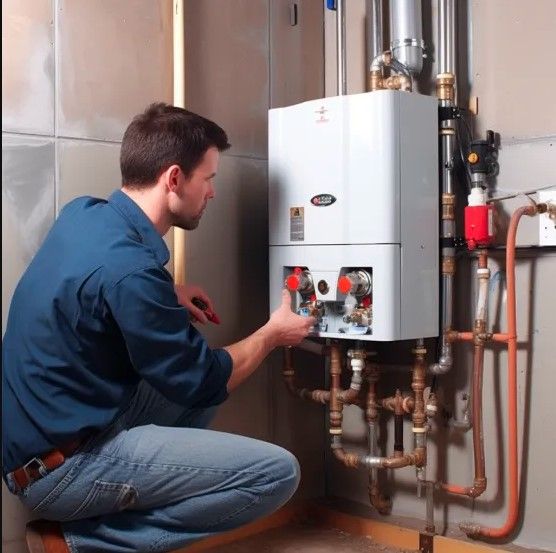
Which of these three quotes is for the job your house actually needs? That was the question a Leander homeowner was stuck on with three written bids for one 50 gallon gas tank spread across his counter, and the reason he went looking for water heater services leander tx in the first place was that no two of them described the same work. The low bid was $1,500. The high one came in at $2,900 and ran two pages, thick with acronyms, venting notes and warranty language nobody had bothered to explain.
Three Quotes Priced One Tank Three Ways
A $1,400 spread on the same equipment is not a haggling problem. It is a signal that three companies scoped three different jobs. A March 2026 cost breakdown from TekmagListings put a gas tank replacement, unit and professional labor together, at $1,300 to $2,400, and that range is wide for a reason: venting work, permit fees and code items like an expansion tank move the total far more than the brand stamped on the tank does. So the comparison has to happen line by line rather than total against total, and the shop that puts venting, permits and a multi-year parts and labor warranty in writing is the one you can actually hold to its number.
First Hour Rating Matters More Than Gallons
Gallons tell you what the tank holds. First hour rating, which the trade shortens to FHR, tells you how much hot water you can draw in the first sixty minutes of real demand, meaning the tank plus whatever the burner can reheat while you are using it. Two 50 gallon heaters can sit 20 gallons apart on that number, which is one shower somebody does not get. Job after job, the callback we see most often is not a failed tank at all but a correctly sized tank recovering too slowly for a house that added a bathroom since the last install. Ask any shop bidding water heater services leander tx which rating it sized to, and why.
What Each Quote Line Actually Includes
Set the three quotes side by side and read down the page instead of across it. The gaps surface quickly. One bid folds in the permit, the next lists it as owner-provided, the third never mentions inspection at all. Haul-away of the old heater is the other line that quietly evaporates, and it is worth somewhere around $75 to $150 of a crew’s afternoon.
Example Illustrative Comparison: Common Water Heater Quote Line Items (Not based on actual quotes; shown for reference)
| Line Item | Typically Included | Often Omitted | Questions to Ask |
| Equipment (Tank/Unit) | Yes | Rarely | Brand, warranty, capacity |
| Venting and Combustion Air | Sometimes | Often | Code-compliant venting path, test results |
| Permit and Inspection | Varies | Sometimes | Who files, who pays, timeline |
| Expansion Tank | Sometimes | Often | Required by code, sized correctly |
| Haul-Away of Old Unit | Sometimes | Often | Included or additional cost |
| Warranty (Parts/Labor) | Yes | Details vary | Years covered, what’s excluded |
Venting And Combustion Air Are Not Extras
Venting is usually where the cheap quote got cheap. A gas heater has to move exhaust out of the building, and it needs makeup air to burn cleanly in the first place, which is why a closed garage or a converted closet often needs work the original install never accounted for. Swapping an atmospheric tank for a taller or higher-input model can leave the existing flue undersized, and a flue that cannot pull properly draws combustion gas back into the room instead of sending it up. That condition is called backdrafting, and it puts carbon monoxide inside the house. So here it is plainly: if you smell gas, or a carbon monoxide alarm sounds, get everyone out of the building first, then call 911 or the gas utility from outside. Do not walk back in to look at the heater. The U.S. Fire Administration recommends that any home with a fuel-burning furnace or heater carry CO alarms in a central location outside each separate sleeping area and on every level of the home, and a working alarm is the cheapest line item anywhere in this conversation.
Worth mentioning, since it comes up on every one of these calls: the same combustion air question is what pushes plenty of homeowners toward tankless or heat pump units, and the heat pump math in a Central Texas garage is genuinely interesting, because the unit cools the garage as a side effect while it heats your water. That is a different article. Back to the page in front of you: if venting and combustion air appear nowhere on it, the bid is writing a check the inspector will bounce, and the difference reaches you later as a change order.
Questions To Ask Before You Sign
Most of what matters on a quote is missing rather than wrong, so you have to ask for it out loud. Do it by phone and write each answer next to the bid it belongs to. A contractor who answers in specifics is telling you it has done this exact swap before, in a garage shaped like yours.
- What is the first hour rating of the unit you quoted, and how did you size it for my household? A good answer names a number and the fixture count behind it.
- Is the permit and city inspection included at this price, and who files it? A good answer says who pays the fee and how long scheduling usually takes.
- Does the price cover an expansion tank, new water and gas connectors, and haul-away of the old heater? A good answer itemizes each one instead of waving at it.
- What does the warranty cover, in years, for parts and for labor separately? A good answer separates the manufacturer’s tank coverage from the shop’s own labor coverage.
- If the flue turns out to be undersized once the old unit is off the wall, what happens to this price? A good answer describes the likely fix and a dollar figure.
The Cheapest Quote Usually Left Something Out
The low bid is rarely a trick. It is a narrower scope, written by somebody who assumed the venting was fine and the permit was somebody else’s problem. Read all three as three different jobs, get the missing lines added in writing, and that $1,400 spread tends to collapse into a couple hundred dollars of genuine difference. Then choose the licensed shop willing to commit venting, permits and a multi-year parts and labor warranty to paper, because paper is the only part of a quote anyone can be held to nine months from now.