Cash Counters in 2026: Why Smart Automation is Now Non-Negotiable
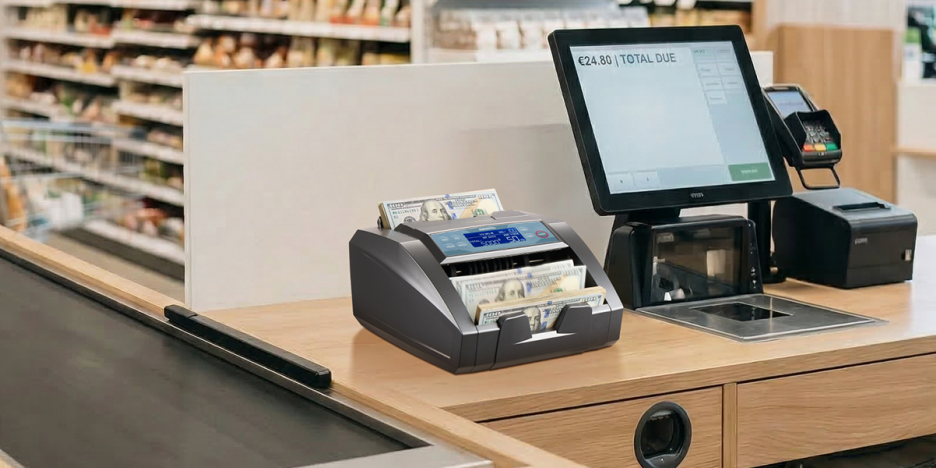
In 2026, manual cash counting isn’t just inefficient—it’s increasingly indefensible for regulatory and security reasons. The technology has evolved far beyond simple bill counting. Modern cash counters now feature AI-powered authentication, cloud connectivity, predictive analytics, and integration capabilities that fundamentally transform cash management.
The global currency counting machine market is growing from $1.5 billion in 2025 to $1.63 billion in 2026, projected to reach $2.24 billion by 2030 at 8.3% CAGR. But this isn’t merely about more machines—it’s about smarter technology solving problems that didn’t exist five years ago. This guide explores why the cash counter conversation has shifted, what’s driving enterprise adoption, and what your business needs to know about next-generation solutions.
The Compliance Crisis: Why Manual Counting is Becoming Indefensible
Here’s what’s changed most dramatically since 2024: regulatory expectations have evolved. Banks, retail chains, and hospitality operators now face increasing pressure to demonstrate robust, documented cash handling protocols. Auditors aren’t checking just numbers anymore—they’re verifying processes, authentication methods, and data trails.
Manual cash counting creates multiple compliance vulnerabilities:
Audit Trail Gaps: Cash handling regulations increasingly require documented evidence of authentication. Manual counting leaves no trace. You can’t prove a bill was examined for counterfeits, when discrepancies occurred, or who performed the count.
Counterfeit Verification Standards: Recent innovations include UV detection with 30x higher resolution for more accurate counterfeit detection and precise banknote sorting. Banks now expect businesses to demonstrate they’re using these advanced methods. A manager’s visual inspection doesn’t meet contemporary standards anymore.
Shrinkage Attribution: Manual counting creates dangerous ambiguity. Was that $50 discrepancy employee theft, customer error, or miscounting? Without authentication trails, you can’t prove anything. This liability falls entirely on the business.
Insurance & Risk Management: In 2026, many machines come equipped with smart technology features such as connectivity options allowing integration with accounting software and POS systems, automating cash reporting and providing real-time insights into cash flow. Insurers now offer better rates for businesses using documented, automated counting systems. Conversely, some carriers question claims from businesses still relying on manual processes.
The economic calculus has shifted entirely. A 50-minute manual count process isn’t just labor cost anymore—it’s regulatory risk, audit vulnerability, and insurance liability. The math now favors automation decisively.
Next-Generation Technology: How 2026 Cash Counters Work
Modern cash counters are no longer simple counting devices—they’re intelligent authentication platforms that function as core business infrastructure.
Multi-Layer AI Authentication: Today’s machines employ sophisticated sensor fusion combined with machine learning. When a bill enters the machine, simultaneous analysis occurs across multiple dimensions:
- High-Resolution UV Detection: Technology 30x more advanced than previous generations, identifying security features with precision
- Infrared Analysis: Detecting ink properties and security threads invisible to human eyes
- Magnetic Sensing: Verifying magnetic security elements and authentication stripes
- Dimensional Verification: Checking paper thickness, width, and length against exact specifications
- AI Pattern Recognition: Intelligent systems that learn emerging counterfeit techniques and adapt in real-time
This comprehensive verification creates authentication certainty impossible through visual inspection.
Cloud-Connected Intelligence: Modern cash counters aren’t standalone devices anymore. Results automatically sync to your accounting software, POS system, and management dashboard. Managers see cash totals in real-time—no waiting for end-of-day reconciliation.
Some systems provide predictive analytics, detecting patterns that suggest counterfeit introduction, unusual transaction volumes, or operational anomalies. This intelligence helps prevent problems before they materialize.
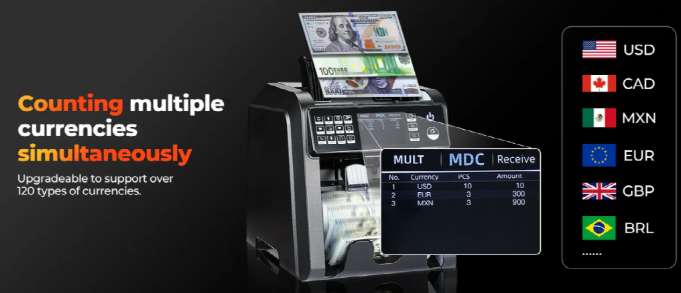
Mixed-Denomination Processing: Advanced machines handle complex scenarios automatically. A single hopper can contain $5, $10, $20, $50, and $100 bills. The machine identifies each denomination, calculates total value, and sorts into separate pockets—all automatically.
Documented Authentication Trails: Premium models read serial numbers and record complete chains of custody. This creates the audit documentation that regulatory bodies expect, satisfying compliance requirements automatically.
The Business Case: Why 2026 Demands Smart Cash Handling
Beyond compliance, smart cash counters create genuine operational value:
Operational Efficiency: A typical machine processes 1,000-1,300 bills per minute. What requires 45 minutes manually takes 90 seconds. For multi-register operations, this transforms daily close procedures from extended tasks into quick, reliable routines.
Theft Deterrence: Automated counting creates clear accountability. Every note is logged. Discrepancies become immediately obvious. This transparency reduces employee theft and provides documentation if loss occurs.
Improved Financial Reporting: Precise cash counts make your financial reporting more reliable. Banking relationships improve when reconciliation is perfect. Auditing becomes friction-free.
Risk Reduction: Cash handling remains essential across retail, hospitality, banking, gaming, fuel stations, and other cash-intensive sectors, with demand for reliable machines expected to remain strong in 2026 as businesses focus on efficiency, reconciliation speed, and counterfeit detection. Smart counters address all three requirements simultaneously.
Real-Time Decision Making: Cloud connectivity means leadership sees cash flow data instantly. You can spot trends, identify issues, and make operational adjustments in real-time rather than discovering problems days later.
2026 Technology Features That Matter
When evaluating cash counters, several features directly impact real-world performance:
Authentication Methods: Entry-level machines use UV and magnetic detection. Premium systems employ 12-point verification including dimensional analysis, ink properties, security features, and serial number recognition. Thoroughness correlates directly with security.
Processing Speed: Modern machines range from 800- 1,400 bills/minute. Choose based on actual volume—a small retail shop with $2,000 daily cash needs a different speed than a chain with $50,000+ transactions.
Cloud Integration: Can the machine sync with your accounting software? Does it support API connections to your POS system? This integration transforms the machine from a standalone device into a business intelligence system.
Operating Modes: Look for flexible counting modes—count-only, value-mode, batch mode, add mode. Different scenarios demand different functions.
Touchscreen Interface: Modern machines feature responsive touchscreen controls. Intuitive interfaces reduce operator error and improve usability.
Multi-Currency Support: For businesses handling international transactions, currency support matters. Premium models support multiple currencies with downloadable updates.
Noise Level: Machines operating under 60dB work better in customer-facing environments. Excessive noise impacts customer experience.
Real-World Applications Across Industries
Retail & Quick Service: End-of-shift reconciliation becomes fast and accurate. Multiple registers consolidate and verify in minutes rather than hours.
Banking & Credit Unions: Teller operations and vault management depend on rapid verification. Banks have used cash counters for decades because operational requirements demand absolute accuracy.
Casinos & Gaming: High-volume cash operations with strict regulatory requirements make counters non-negotiable.
Hospitality: Hotels and entertainment venues handling enormous daily cash volumes benefit from automation that protects against errors and internal theft.
Armored Car & Cash Transport: Handling multiple currencies and high-value transfers depends entirely on automated systems.
Fuel Stations & Convenience Retail: Continuous cash flow throughout the day requires reliable end-of-shift verification.
Finding Solutions: MUNBYN Cash Counters
When evaluating options, MUNBYN offers cash counter solutions specifically designed for diverse business needs. Their approach addresses businesses ranging from independent retailers to financial institutions.
For understanding what your operation actually requires, the best money counter for small business requires assessing your specific needs. MUNBYN’s offerings address this by providing models at different feature levels and price points.
Their entry-level machines handle basic counting with counterfeit detection, suitable for small businesses. Mid-range models add mixed-denomination and multi-currency support. Premium offerings include two-pocket sorting, printing, and advanced detection methods rivaling bank-grade systems.
When ready to implement automated cash handling, the cash counter collection provides machines from 800-1,300 bills/minute with detection ranging from basic UV/MG/IR to comprehensive 12-point verification. The variety matters because it allows matching the right technology to your actual operational requirements rather than overpaying for unnecessary features.
The Verdict
In 2026, manual cash counting is indefensible for any business processing significant cash volume. The technology is proven, affordable, and addresses real operational and compliance problems. The question isn’t whether to implement a cash counter—it’s which one matches your specific requirements. That decision depends on daily volume, cash composition, available space, and integration needs. What’s certain is that cash counters have become business infrastructure, not luxury equipment. Successful organizations recognize this transformation and implement accordingly.