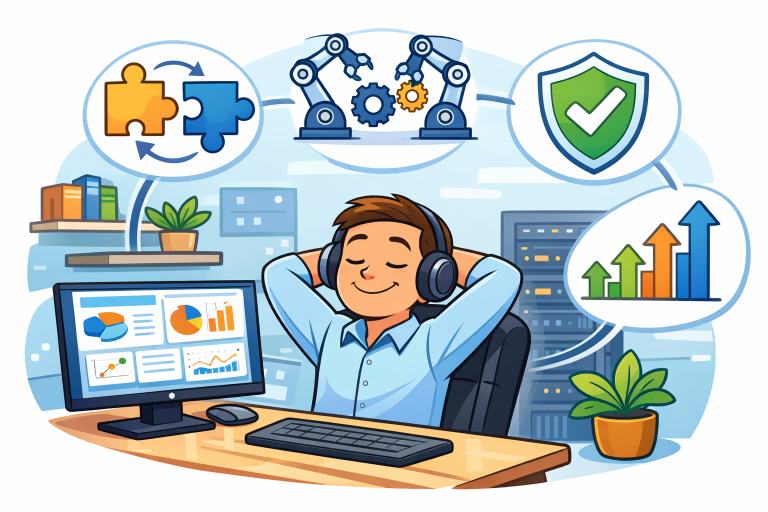
How AI Is Making SaaS Applications Smarter and More Personalized

A SaaS application can have an impressive list of features and still feel frustrating to use. However, the issue may not always be the app itself; it may have more to do with the user’s workload.
Users need to generate reports, go through dashboards, search for information they want, remember deadlines, and figure out what is useful. For a long time, SaaS apps have been improving their ability to handle these tasks, whereas today AI is changing the game because it gives software the ability to understand context.
This is the point where the main change is happening. AI is not limited to adding another chatbot or content generator into a SaaS solution. AI is changing applications into something responsive for the users. When businesses are looking for AI software development services, they see personalization as one of the effective solutions.
SaaS Is Moving Beyond One-Size-Fits-All Experiences
In traditional SaaS applications, each user has access to the same features and interface, and even though different users can have different permissions based on their roles, the experience remains similar for all of them.
AI takes personalization a step further.
While a project manager looks at urgent tasks that need to be completed, a developer sees issues concerning the same project from a technical point of view. A sales representative receives suggestions for leads that are likely to close, and a sales manager is able to look at the bigger picture of the sales pipeline.
Thus, the app is no longer simply presenting information; it selects the information that is most relevant for a particular user. This is why companies building SaaS application development solutions are more focused on integrating personalization at early stages.
What Makes an AI-Powered SaaS Experience Different?
AI-powered SaaS takes personalization a step ahead of simple dashboard customization. It analyzes user behavior and interactions, which are then used to provide suggestions, automate actions, and make users’ experiences far more personal.
Some common examples include:
| AI Capability | How It Personalizes the SaaS Experience |
| Personalized dashboards | Highlights information based on a user’s role and activity |
| Smart recommendations | Suggests relevant products, content, actions, or next steps |
| Predictive analytics | Identifies patterns and potential outcomes from historical data |
| Intelligent search | Understands natural-language queries instead of relying only on keywords |
| Behavioral learning | Adjusts recommendations based on how users interact with the platform |
| Automated workflows | Suggests or triggers actions based on user behavior and context |
| AI assistants | Provides contextual help without requiring users to search through documentation |
| Content personalization | Delivers messages and resources based on user interests or activity |
The important part is that personalization should improve the experience without becoming intrusive.
Recommendations Are Becoming More Useful
Recommendation engines have been around for a long time. E-commerce businesses recommend products, streaming services suggest movies, and social networks organize users’ feeds. AI is just making it better.
Imagine opening a CRM not just to a list of leads, but to a concise evaluation of which accounts need attention and the reasons why. Now think of a project management service that detects recurring delays at one of the workflow stages and proposes adjustments in how things are done.
Such suggestions can save users from the trouble of understanding the data on their own.
But there is one important thing to keep in mind: relevance is key.
If a SaaS offers a user advice that has little use in their actual job, they will stop following such pointers. Personalization rests heavily on the quality of data used by the system.
AI Can Make Search Feel Completely Different
The search feature is completely changed with AI. Earlier, Search was all about matching words, and now with AI-powered search, the software understands the user’s intent.
For example, a director can type “Show me the customers who might churn this quarter,” and receive a filtered list with the information that takes into account usage, account history, support contact, and other data.
However, this does not mean that every AI-powered search result is always right. Instead, it allows the user to use the software similar to asking a qualified colleague.
Personalization Depends on Good Data
The truth about intelligent SaaS applications remains unpleasant: AI can not be trusted if data isn’t reliable.
The software may contain thousands of customers’ records, but if the information is both outdated and duplicated, as well as stored in different systems, the potential of AI won’t be extensive.
Before adding personalization, businesses need to improve:
- Data collection
- Customer profiles
- API integrations
- Event tracking
- Data quality checks
- Access permissions
- Storage and retrieval systems
This work isn’t particularly exciting, but it often determines whether an AI feature succeeds once real customers start using it.
The Interface Shouldn’t Become More Complicated
Adding AI can make the SaaS product look more complicated, and it can increase bounce rate.
A screen with all the AI recommendations can feel overwhelming.
Good personalization should have the opposite effect.
It should remove what is unnecessary and should help users to focus more on what deserves attention.
This is where product design becomes just as important as the underlying model.
Personalization Can Improve Retention Too
There is a difference between personalization and automation.
For example, a SaaS platform can suggest that a sales agent contact their client again, but this does not mean that the email should be sent automatically without asking.
A good AI system can detect an unusual financial transaction but not necessarily block the account due to that.
The best AI-powered SaaS products are not trying to eliminate people from processes; they want to make this process easier.
Where AI-Powered SaaS Is Heading
Coming back to the task of integrating AI into SaaS software solutions, one can speculate on what the next generation of such applications will look like. Instead of entering an application’s dashboard in order to see what things are demanding attention, users may find out that the software has sorted out all the necessary information, highlighted the possible problems, and determined what to do next.
It does not mean that every application needs to pack lots of AI capabilities throughout the application interface. The truly efficient products are those which can implement AI in such a way as to strengthen their functions and without any need of users to pay attention to these AI applications.
Conclusion
The true worth of AI in SaaS is not that applications can now create text, perform data analysis, or respond to inquiries. Rather, it lies in the software’s capacity to comprehend who its user is.
An application that is cognizant of the user’s function, behavior patterns, priorities, and past interactions can help in eliminating a lot of repetitive tasks. However, this requires much more than simply plugging in an AI model into an already existing app. What it needs is high-quality data, a carefully designed product, effective infrastructure, and a precise definition of the range of work to be done by automation.
With the evolution of SaaS, more and more personalization will be introduced into its processes rather than being a privilege. The applications that get things right will be the ones that stand out.
About the Author:
Sanjay Singh Rajpurohit is the Founder & CEO of Technource, a product engineering company with over 13 years of experience helping startups and businesses design, build, and scale digital platforms, SaaS systems, and AI-powered workflow automation solutions. He works closely with clients to define product strategy, identify scalable architecture, and guide organizations through product engineering, MVP development, and platform modernization initiatives.
His expertise lies in translating business ideas into structured digital solutions, including marketplace platforms, business systems, and custom SaaS applications. Sanjay frequently writes about product engineering strategy, build vs buy decisions, platform scalability, and technology planning for startups and growing businesses.
He also contributes insights on digital transformation, AI-driven automation, and platform-based architecture, helping organizations move from concept to scalable product ecosystems.